Close Menu
  • Articles
    • Learn Electronics
    • Product Review
    • Tech Articles
  • Electronics Circuits
    • 555 Timer Projects
    • Op-Amp Circuits
    • Power Electronics
  • Microcontrollers
    • Arduino Projects
    • STM32 Projects
    • AMB82-Mini IoT AI Camera
    • BLE Projects
  • IoT Projects
    • ESP8266 Projects
    • ESP32 Projects
    • ESP32 MicroPython
    • ESP32-CAM Projects
    • LoRa/LoRaWAN Projects
  • Raspberry Pi
    • Raspberry Pi Projects
    • Raspberry Pi Pico Projects
    • Raspberry Pi Pico W Projects
  • Electronics Calculator
Facebook X (Twitter) Instagram
  • About Us
  • Disclaimer
  • Privacy Policy
  • Contact Us
  • Advertise With Us
Facebook X (Twitter) Instagram Pinterest YouTube LinkedIn
How To Electronics
  • Articles
    • Learn Electronics
    • Product Review
    • Tech Articles
  • Electronics Circuits
    • 555 Timer Projects
    • Op-Amp Circuits
    • Power Electronics
  • Microcontrollers
    • Arduino Projects
    • STM32 Projects
    • AMB82-Mini IoT AI Camera
    • BLE Projects
  • IoT Projects
    • ESP8266 Projects
    • ESP32 Projects
    • ESP32 MicroPython
    • ESP32-CAM Projects
    • LoRa/LoRaWAN Projects
  • Raspberry Pi
    • Raspberry Pi Projects
    • Raspberry Pi Pico Projects
    • Raspberry Pi Pico W Projects
  • Electronics Calculator
How To Electronics
Home » DIY 5V 3A USB Charger for Car or Solar Panel (4-30V Input)
Electronics Circuits Power Electronics

DIY 5V 3A USB Charger for Car or Solar Panel (4-30V Input)

Mamtaz AlamBy Mamtaz Alam4 Mins Read
Share Facebook Twitter LinkedIn Telegram Reddit WhatsApp
DIY 5V 3A USB Charger for Car or Solar Panel
Share
Facebook Twitter LinkedIn Pinterest Email Reddit Telegram WhatsApp

Overview:

In this project, we will build a DIY 5V 3A USB Charger designed specifically for cars or solar panels using the NS6326B IC. This versatile charger is engineered to accept a wide input voltage range of 4-30V, making it highly adaptable to various power sources, from automotive batteries to solar-generated electricity. The NS6326B IC at its core ensures efficient voltage regulation and stable power delivery, ensuring your devices receive a consistent 5V output.

The charger boasts features like over-voltage protection, current sampling, and a robust power switch output mechanism, ensuring safety and reliability in diverse environments. Its 3A output capability ensures rapid charging for most USB-powered devices, from smartphones to tablets. Given its flexibility in input voltage and compact design, this charger is ideal for on-the-go applications, be it in cars, RVs, or remote locations powered by solar panels.


Bill of Materials

The following are the components required to make a 5A 3A USB Charger Circuit.

S.N.ComponentsQuantityPurchase Link
1NS6326 IC1AliExpress
2100uF/35V electrolytic capacitor1AliExpress
3470uF/16V electrolytic capacitor1AliExpress
40.1uF Capacitor 08051AliExpress
547uH Inductor1AliExpress
6USB Type A Port Female 2AliExpress
7LED 0805 (Red)1AliExpress
8Resistor 0805 (220-ohm)1AliExpress


NS6326B 4-30V Input 5V/3A Output Synchronous Buck Regulator

The NS6326B is a synchronous buck power management chip that supports high-voltage inputs. It can achieve a continuous current output of 3A within a wide input voltage range of 4~30V.
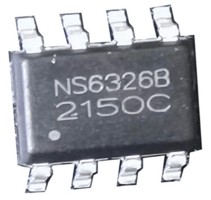
NS6326B IC

The NS6326B has excellent constant voltage/constant current (CC/CV) characteristics. It uses a current mode loop control principle to achieve a fast dynamic response. The NS6326B operating switching frequency is 130kHz, which has good EMI characteristics. Additionally, the chip includes multiple protection functions: over-temperature protection, output short circuit protection, and input under-voltage/over-voltage protection. The NS6326B uses a standard SOP8 package.

Features of NS6326B

  • Wide input voltage range: 4V to 30V
  • Efficiency up to 92% and above
  • High constant current accuracy: ±5%
  • Constant voltage accuracy: ±5%
  • No external compensation required
  • Switching frequency: 130kHz
  • Input under-voltage/over-voltage, output short circuit, and overheat protection
  • SOP-8 package
  • Output current: 3A

Pin Configuration

The SOP-8 pin diagram is shown, detailing the functions of each pin.
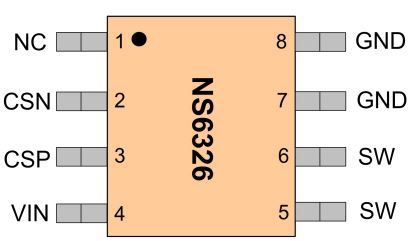
NS6326B Pinout

Pin Number Pin Name Description Function
1 NC Floating Pin –
2 CSN Output Voltage Output voltage pin
3 CSP Current Sampling Pin This pin is used to detect and set the output constant current value; the size of the output constant current value is set by R3: ICC-Mode = Vcs/R3 ​
4 VIN Power Supply Power supply pin, this pin should be connected to at least a 100uF/35V electrolytic capacitor to the ground to avoid large voltage fluctuations at the input during operation
5,6 SW Power Switch Output This pin is the switch node, connected to the inductor, used for power output to the load
7,8 GND Ground Ground pin


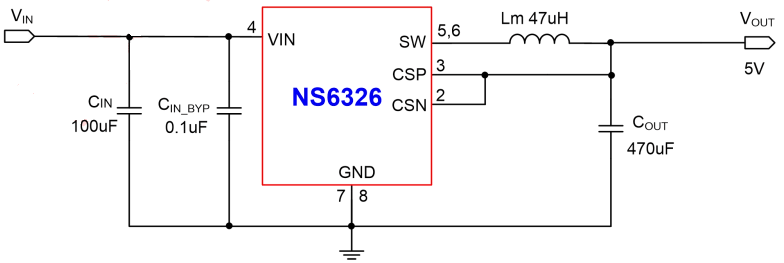
NS6326B Typical Application Circuit

NS6326B Typical Application Circuit

Application Range

  • Car chargers/adapters
  • Linear regulator pre-regulators
  • Distributed power systems
  • Battery chargers

5V 3A USB Charger Circuit

Let us take a look at the 5V 3A USB Charger Circuit for a Car or Solar Panel. The schematic is modified from the NS6326B Typical Application Circuit.

Schematic 5A 3A USB Charger

In this schematic, the terminal J1 can be used for power input which can range from 4-30V. The input source could be a 12V Battery or a DC Adapter Supply. The input could also be a 24V Solar Panel.

The output can be taken from a pair of Male USB A ports. A terminal J2 is also provided so that a header or a jumper wire can be soldered to take power input.

Using the above schematic, you can design your own custom PCB. I used PCB for my project and soldered all the necessary components on it.

5V 3A USB Charger

All the components on the front side and back side are soldered as per the circuit diagram.
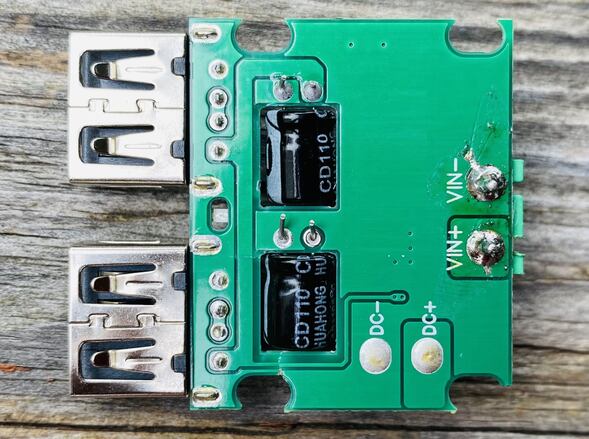


Testing & Operations

After assembling the hardware, you can start testing the PCB Board. You may connect a 12V Lead-Acid Battery at Input terminal.
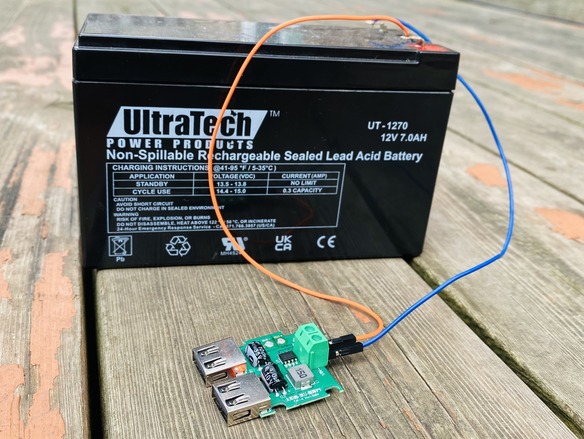
12V to 5V Battery Output

The on-board LED on the board will turn on indicating the board is powered on. You may use a multimeter to check the input and the output voltage.

Similarly, instead of 12V DC Battery, you may connect a 24V Solar Panel.
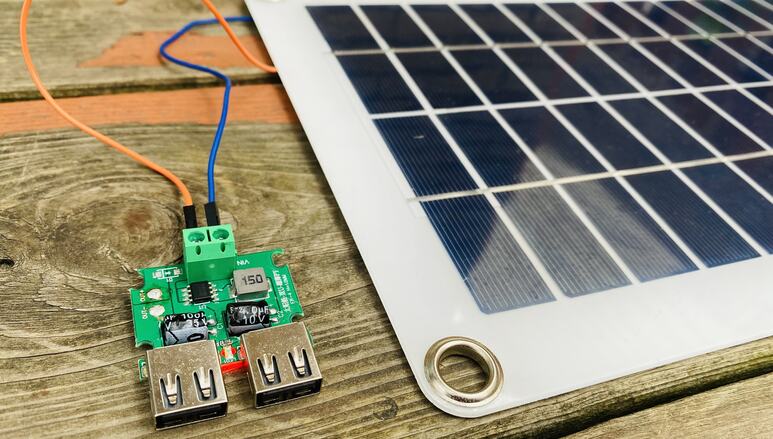
24V Solar Panel 5V output

You can charge your mobile phone using the USB Port.
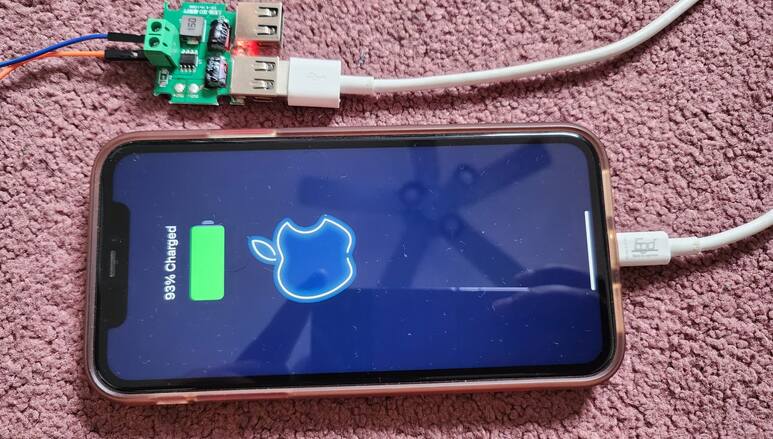
The 5V 3A USB Charger can be useful is so many other applications that requires constant power source.

Share. Facebook Twitter Pinterest LinkedIn Tumblr Email Reddit Telegram WhatsApp
Previous ArticleConnecting RS485 Soil Moisture & Temperature Sensor to Arduino
Next Article How to use MCP4725 12-Bit DAC Module with Arduino

Related Posts

Water Level Alert using Float Sensor & 555 Timer

Water Level Alert using Float Sensor & 555 Timer

2K
Adjustable Auto On Off Delay Timer Circuit Using 555 IC

555 Based Adjustable Auto On Off Delay Timer Circuit

Updated:February 14, 20252K

12V DC to 220V AC Inverter Circuit & PCB

Updated:February 2, 20251460K
DIY Smart Blind Stick using Op-Amp & IR Sensor

DIY Smart Blind Stick using Op-Amp & IR Sensor

Updated:February 2, 202515K
Square Wave Generator Circuit with Op Amp IC LM358

Square Wave Generator Circuit with Op Amp IC LM358

Updated:February 2, 202513K
Gas Leak Detection & Alarm using 555 Timer IC

Gas Leak Detection & Alarm using 555 Timer IC

Updated:February 2, 202525K
Add A Comment

CommentsCancel reply

Latest Posts
IoT Based PM & Air Quality Monitoring System using ESP32

IoT Based PM & Air Quality Monitoring System using ESP32

May 31, 2026
DIY ESP32 MLX90640 IR Thermal Camera with Live Web Display

DIY ESP32 MLX90640 IR Thermal Camera with Live Web Display

May 10, 2026
IoT Activity Tracker with ESP32 & Accelerometer Gyroscope

IoT Activity Tracker with ESP32 & Accelerometer/Gyroscope

May 2, 2026
A Guide to Sourcing Obsolete ICs for Vintage Projects

Beyond AliExpress: A Guide to Sourcing Obsolete ICs for Vintage Projects

April 21, 2026

ESP32 IoT Vehicle Motion Analyzer with MPU6050 & LIS3MDL

April 27, 2026
Building a Smart Sensor Node with a BLE Microcontroller

Building a Smart Sensor Node with a BLE Microcontroller

February 26, 2026
High-Accuracy Pitch, Roll, Yaw with ESP32 & BNO08x IMU

High-Accuracy Pitch, Roll, Yaw with ESP32 & BNO08x IMU

April 27, 2026
DIY Colorimeter using AS7265x Spectroscopy Sensor & ESP32

DIY Colorimeter using AS7265x Spectroscopy Sensor & ESP32

February 1, 2026
Top Posts & Pages
  • 12V DC to 220V AC Inverter Circuit & PCB
    12V DC to 220V AC Inverter Circuit & PCB
  • IoT AC Energy Meter with PZEM-004T & ESP32 WebServer
    IoT AC Energy Meter with PZEM-004T & ESP32 WebServer
  • How to use INA226 DC Current Sensor with Arduino
    How to use INA226 DC Current Sensor with Arduino
  • Designing of MPPT Solar Charge Controller using Arduino
    Designing of MPPT Solar Charge Controller using Arduino
  • Buck Converter: Basics, Working, Design & Application
    Buck Converter: Basics, Working, Design & Application
  • DIY Turbidity Meter using Turbidity Sensor & Arduino
    DIY Turbidity Meter using Turbidity Sensor & Arduino
  • ECG Graph Monitoring with AD8232 ECG Sensor & Arduino
    ECG Graph Monitoring with AD8232 ECG Sensor & Arduino
  • How to use INA219 DC Current Sensor Module with Arduino
    How to use INA219 DC Current Sensor Module with Arduino
Categories
  • Arduino Projects (197)
  • Articles (60)
    • Learn Electronics (19)
    • Product Review (15)
    • Tech Articles (28)
  • Electronics Circuits (46)
    • 555 Timer Projects (21)
    • Op-Amp Circuits (7)
    • Power Electronics (13)
  • IoT Projects (204)
    • ESP32 MicroPython (7)
    • ESP32 Projects (81)
    • ESP32-CAM Projects (15)
    • ESP8266 Projects (76)
    • LoRa/LoRaWAN Projects (22)
  • Microcontrollers (38)
    • AMB82-Mini IoT AI Camera (4)
    • BLE Projects (18)
    • STM32 Projects (19)
  • Raspberry Pi (93)
    • Raspberry Pi Pico Projects (57)
    • Raspberry Pi Pico W Projects (12)
    • Raspberry Pi Projects (24)
Follow Us
  • Facebook
  • Twitter
  • Pinterest
  • Instagram
  • YouTube
About Us

“‘How to Electronics’ is a vibrant community for electronics enthusiasts and professionals. We deliver latest insights in areas such as Embedded Systems, Power Electronics, AI, IoT, and Robotics. Our goal is to stimulate innovation and provide practical solutions for students, organizations, and industries. Join us to transform learning into a joyful journey of discovery and innovation.

Copyright © How To Electronics. All rights reserved.
  • About Us
  • Disclaimer
  • Privacy Policy
  • Contact Us
  • Advertise With Us

Type above and press Enter to search. Press Esc to cancel.

Ad Blocker Enabled!
Ad Blocker Enabled!
Looks like you're using an ad blocker. Please allow ads on our site. We rely on advertising to help fund our site.