


In this tutorial we will learn about Square Wave Generator Circuit with Op-Amp IC 741. The operational amplifier can be configured to generate the Triangular Wave Form.
Overview
Op-amp 741 IC is one of the most popular and versatile operation amplifiers and can be used in a lot of applications including, comparator, wave generator, amplifier, etc.
A square wave generator is an electronic circuit, which generates a square wave. The operational amplifier-based square waveform generator is a simple circuit that is widely used in function generators. The circuit for the Square wave generator is designed using 741 op amp.
Bill of Materials
Following are the components required for learning this tutorial practically.
| S.N. | Components | Description | Quantity |
|---|---|---|---|
| 1 | Resistor | 10 KΩ | 2 |
| 2 | Resistor | 12 KΩ | 1 |
| 3 | Capacitor | 1 µF, 16V (Electrolytic Capacitor) | 1 |
| 4 | Op-Amp IC | LM741 | 1 |
Op-Amp IC LM741
LM741 is an operational amplifier IC packed with many features. The IC is available in many different packages. The number of transistors used in the internal circuitry of the IC is 20. The IC can be used in a wide range of analog projects.
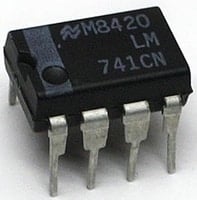
Its feature like high gain, low current consumption, and wide supply voltage makes it ideal to use in battery-operated circuits. Moreover, the IC is also overload protected from both sides i.e. input and output, this feature saves the internal circuitry of the IC from damage by overload.
Check the IC LM741 Datasheets
Square Wave Generator Circuit Diagram
The circuit for square wave generator using Op-Amp is shown in the figure below. One capacitor is connected to the inverting terminal of an op-amp with one pin connected to the ground, and a resistor for charging and discharging the capacitor is also connected to the inverting terminal to output.

One voltage divider is designed using two resistors & is connected to output and ground at the non-inverting pin.
Working of Square Wave Generator Using Op-Amp 741
Let us assume the voltage at inverting terminal be V2 which equals to the voltage across the capacitor. Also, let us assume the voltage at the non-inverting terminal be V1. The voltage difference between non-inverting and inverting terminal is referred to as differential input voltage and is given by Vin.
At the initial state when the capacitor is fully discharged, the voltage at inverting pin will be zero, i.e. V2 = 0V
Therefore, input differential voltage (Vin) = V1-V2 = V1-0 = V1
When Vin is positive the output is also positive, at this instance, the capacitor starts to charge through resistor R2 towards positive saturation voltage until V1 = V2.
When the voltage at the capacitor increases slightly more than the differential voltage V1.
Negative Vin = V1-V2 (V2>V1)
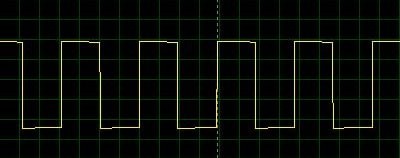
Then the output will be switched from positive saturation voltage to negative saturation voltage. In this instance, the capacitor starts to discharge through resistor R2 because V2 becomes greater than Vout. Again, after reaching V2 slightly less than V1 the output will again switch to positive saturation voltage. This process repeats again and again as a result square wave is generated.
Circuit Simulation
The circuit can be simulated using Proteus Software. The below circuit simulation gives the perfect output on the Oscilloscope. You can change the value of resistors to observe the change in the waveform.

You can also check this post: Triangular Wave Generator Circuit with Op Amp IC 741 and in order to view the waveform you can design your own DIY Oscilloscope at home.


2 Comments
Hello! It`s difficult to have two polar ( 5V/-5V for example) power supply in mobile devices. Is it any OP AMP generator for single power supply?
I built the abovr square wave cct, but doesnt work. I nhave double checked the layout, but still does not work