Close Menu
  • Articles
    • Learn Electronics
    • Product Review
    • Tech Articles
  • Electronics Circuits
    • 555 Timer Projects
    • Op-Amp Circuits
    • Power Electronics
  • Microcontrollers
    • Arduino Projects
    • STM32 Projects
    • AMB82-Mini IoT AI Camera
    • BLE Projects
  • IoT Projects
    • ESP8266 Projects
    • ESP32 Projects
    • ESP32 MicroPython
    • ESP32-CAM Projects
    • LoRa/LoRaWAN Projects
  • Raspberry Pi
    • Raspberry Pi Projects
    • Raspberry Pi Pico Projects
    • Raspberry Pi Pico W Projects
  • Electronics Calculator
Facebook X (Twitter) Instagram
  • About Us
  • Disclaimer
  • Privacy Policy
  • Contact Us
  • Advertise With Us
Facebook X (Twitter) Instagram Pinterest YouTube LinkedIn
How To Electronics
  • Articles
    • Learn Electronics
    • Product Review
    • Tech Articles
  • Electronics Circuits
    • 555 Timer Projects
    • Op-Amp Circuits
    • Power Electronics
  • Microcontrollers
    • Arduino Projects
    • STM32 Projects
    • AMB82-Mini IoT AI Camera
    • BLE Projects
  • IoT Projects
    • ESP8266 Projects
    • ESP32 Projects
    • ESP32 MicroPython
    • ESP32-CAM Projects
    • LoRa/LoRaWAN Projects
  • Raspberry Pi
    • Raspberry Pi Projects
    • Raspberry Pi Pico Projects
    • Raspberry Pi Pico W Projects
  • Electronics Calculator
How To Electronics
Home » Hall Effect Sensor A3144 Magnetic Switch Basics Working & Explanation
Electronics Circuits

Hall Effect Sensor A3144 Magnetic Switch Basics Working & Explanation

Mamtaz AlamBy Mamtaz AlamUpdated:February 2, 20253 Comments3 Mins Read
Share Facebook Twitter LinkedIn Telegram Reddit WhatsApp
Hall Effect Sensor A3144 Magnetic Switch Basics Working & Explanation
Share
Facebook Twitter LinkedIn Pinterest Email Reddit Telegram WhatsApp

Introduction:

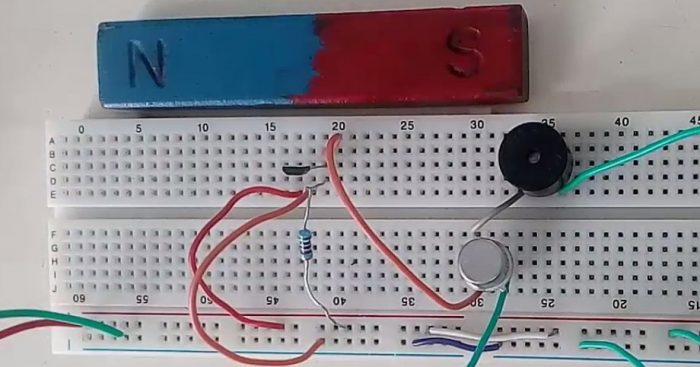
In this tutorial we will learn about Hall Effect Sensor A3144 Magnetic Switch Basics Working & Explanation. We will also design a switching circuit using transistor that will help in detecting magnetic north and south pole. It can also be used to detect the presence of magnetic field. A hall-effect sensor as then name suggests works with the principle of hall-effect and is used to detect magnets. Each side of the sensor can detect one particular pole. It can also be easily interfaced with a microcontroller since it works on transistor logic.


Hall Effect Sensor A3144 Magnetic Switch Basics Working & Explanation

What is Hall Effect Sensor:

Hall Effect Sensor A3144 Magnetic Switch Basics Working & Explanation

The A3144 is an integrated Hall effect non-latching sensor. Holding a magnet near the sensor will cause the output pin to toggle. This makes for a robust presence sensor. A Reed Sensor also works nicely, but can be limited by the glass encapsulation and size.

There are two main types of hall-effect sensor, one which gives an analog output and the other which gives a digital output. A3144 is a digital output hall sensor, meaning if it detects a magnet the output will go low else the output will remain high.


Hall Effect Sensor A3144 Magnetic Switch Basics Working & Explanation

A hall effect sensor is much smaller, but can handle less current than a reed switch. The device includes an on-chip Hall voltage generator for magnetic sensing, a comparator that amplifies the Hall voltage, and a Schmitt trigger to provide switching hysteresis for noise rejection, and open-collector output. An internal bandgap regulator is used to provide temperature compensated supply voltage for internal circuits and allows a wide operating supply range. If a magnetic flux density larger than threshold Bop, the output is turned on (low). The output state is held until a magnetic flux density reversal falls below Brp causing the output to be turned off (high).

Featuresof A3144 Hall Effect Sensor

C++
1
2
3
4
5
6
7
8
1. Superior Temp. Stability for Automotive or Industrial Applications
2. 4.5 V to 24 V Operation … Needs Only An Unregulated Supply
3. Open-Collector 25 mA Output … Compatible with Digital Logic
4. Reverse Battery Protection
5. Activate with Small, Commercially Available Permanent Magnets
6. Solid-State Reliability
7. Small Size
8. Resistant to Physical Stress

Working of Hall Effect Sensor:

When a beam of charged particles passes through a magnetic field, forces act on the particles and the beam is deflected from a straight path. The flow of electrons through a conductor is known as a beam of charged carriers. When a conductor is placed in a magnetic field perpendicular to the direction of the electrons, they will be deflected from a straight path. As a consequence, one plane of the conductor will become negatively charged and the opposite side will become positively charged. The voltage between these planes is called the Hall voltage.

Hall Effect Sensor A3144 Magnetic Switch Basics Working & Explanation

When the force on the charged particles from the electric field balances the force produced by magnetic field, the separation of them will stop. If the current is not changing, then the Hall voltage is a measure of the magnetic flux density. Basically, there are two kinds of Hall Effect sensors. One is linear which means the output of voltage linearly depends on magnetic flux density; the other is called threshold which means there will be a sharp decrease of output voltage at each magnetic flux density.


Hall Effect Sensor Switch Circuit Diagram

Following components are required for designing Hall Effect Sensor switch using A3144 and transistor.

C++
1
2
3
4
5
6
1. A3144 Hall Effect Sensor
2. BC547 or any other NPN Transistor
3. Resistor 1K ohm
4. Breadboard
5. Connecting Wires
6. 12 Volt power Supply

Now assemble the circuit as shown in the circuit diagram.

Hall Effect Sensor A3144 Magnetic Switch Basics Working & Explanation


Video Tutorial: Hall Effect Sensor A3144 Magnetic Switch Basics Working & Explanation

Hall Effect Sensor A3144 Magnetic Switch || Circuit Diagram & Working
Watch this video on YouTube.

Here is an application of Hall Effect Sensor: Arduino Water Flow Meter using Hallf Effect Sensor

Share. Facebook Twitter Pinterest LinkedIn Tumblr Email Reddit Telegram WhatsApp
Previous ArticleRainfall Detector Alarm using 555 Timer & Rain Sensor
Next Article Inductive Water Level Indicator with Display using IC 74HC157 & CD4511

Related Posts

Water Level Alert using Float Sensor & 555 Timer

Water Level Alert using Float Sensor & 555 Timer

2K
Adjustable Auto On Off Delay Timer Circuit Using 555 IC

555 Based Adjustable Auto On Off Delay Timer Circuit

Updated:February 14, 20252K

12V DC to 220V AC Inverter Circuit & PCB

Updated:February 2, 20251461K
DIY Smart Blind Stick using Op-Amp & IR Sensor

DIY Smart Blind Stick using Op-Amp & IR Sensor

Updated:February 2, 202515K
Square Wave Generator Circuit with Op Amp IC LM358

Square Wave Generator Circuit with Op Amp IC LM358

Updated:February 2, 202513K
Gas Leak Detection & Alarm using 555 Timer IC

Gas Leak Detection & Alarm using 555 Timer IC

Updated:February 2, 202525K
View 3 Comments

3 Comments

  1. aaron on May 20, 2021 11:10 AM

    Can this be interfaced directly? ex: to a read port of an arduino?

    Or does this require contact noise filtering ex: Schmidt trigger? Hall effect circuit Looks pretty clean as is.

    Reply
  2. Hub on October 4, 2021 7:41 PM

    It would just require a pullup to be turned on with the Arduino input, since the hall sensor is a ground switched output.

    Reply
  3. Alejandro on December 16, 2023 12:21 PM

    The circuit with the BC547 WON’T WORK properly, because It hasn”t the 10K resistor between the +5V pin and the output pin (connected to the base of the BC547). So the output of the A3144 will be at HIGH IMPEDANCE when no magnetic field is present, (no saturation), and will send to GROUND the base of the BC547 with the magnetic field. I’ve made the circuit exactly as the diagram shows, and DIDN’T WORK.
    Greetings from Argentina!

    Reply

CommentsCancel reply

Latest Posts
ESP32 Fingerprint Attendance System with Live Web Dashboard

ESP32 Fingerprint Attendance System with Live Web Dashboard

June 21, 2026
IoT Based PM & Air Quality Monitoring System using ESP32

IoT Based PM & Air Quality Monitoring System using ESP32

June 14, 2026
DIY ESP32 MLX90640 IR Thermal Camera with Live Web Display

DIY ESP32 MLX90640 IR Thermal Camera with Live Web Display

May 10, 2026
IoT Activity Tracker with ESP32 & Accelerometer Gyroscope

IoT Activity Tracker with ESP32 & Accelerometer/Gyroscope

May 2, 2026
A Guide to Sourcing Obsolete ICs for Vintage Projects

Beyond AliExpress: A Guide to Sourcing Obsolete ICs for Vintage Projects

April 21, 2026

ESP32 IoT Vehicle Motion Analyzer with MPU6050 & LIS3MDL

April 27, 2026
Building a Smart Sensor Node with a BLE Microcontroller

Building a Smart Sensor Node with a BLE Microcontroller

February 26, 2026
High-Accuracy Pitch, Roll, Yaw with ESP32 & BNO08x IMU

High-Accuracy Pitch, Roll, Yaw with ESP32 & BNO08x IMU

April 27, 2026
Top Posts & Pages
  • ESP32 Fingerprint Attendance System with Live Web Dashboard
    ESP32 Fingerprint Attendance System with Live Web Dashboard
  • IoT AC Energy Meter with PZEM-004T & ESP32 WebServer
    IoT AC Energy Meter with PZEM-004T & ESP32 WebServer
  • 12V DC to 220V AC Inverter Circuit & PCB
    12V DC to 220V AC Inverter Circuit & PCB
  • IoT Based ECG Monitoring with AD8232 ECG Sensor & ESP32
    IoT Based ECG Monitoring with AD8232 ECG Sensor & ESP32
  • ESP32 CAN Bus Tutorial | Interfacing MCP2515 CAN Module with ESP32
    ESP32 CAN Bus Tutorial | Interfacing MCP2515 CAN Module with ESP32
  • How to use Modbus RTU with ESP32 to read Sensor Data
    How to use Modbus RTU with ESP32 to read Sensor Data
  • Half Wave Rectifier Basics, Circuit, Working & Applications
    Half Wave Rectifier Basics, Circuit, Working & Applications
  • How to use INA226 DC Current Sensor with Arduino
    How to use INA226 DC Current Sensor with Arduino
Categories
  • Arduino Projects (197)
  • Articles (60)
    • Learn Electronics (19)
    • Product Review (15)
    • Tech Articles (28)
  • Electronics Circuits (46)
    • 555 Timer Projects (21)
    • Op-Amp Circuits (7)
    • Power Electronics (13)
  • IoT Projects (205)
    • ESP32 MicroPython (7)
    • ESP32 Projects (82)
    • ESP32-CAM Projects (15)
    • ESP8266 Projects (76)
    • LoRa/LoRaWAN Projects (22)
  • Microcontrollers (38)
    • AMB82-Mini IoT AI Camera (4)
    • BLE Projects (18)
    • STM32 Projects (19)
  • Raspberry Pi (93)
    • Raspberry Pi Pico Projects (57)
    • Raspberry Pi Pico W Projects (12)
    • Raspberry Pi Projects (24)
Follow Us
  • Facebook
  • Twitter
  • Pinterest
  • Instagram
  • YouTube
About Us

“‘How to Electronics’ is a vibrant community for electronics enthusiasts and professionals. We deliver latest insights in areas such as Embedded Systems, Power Electronics, AI, IoT, and Robotics. Our goal is to stimulate innovation and provide practical solutions for students, organizations, and industries. Join us to transform learning into a joyful journey of discovery and innovation.

Copyright © How To Electronics. All rights reserved.
  • About Us
  • Disclaimer
  • Privacy Policy
  • Contact Us
  • Advertise With Us

Type above and press Enter to search. Press Esc to cancel.

Ad Blocker Enabled!
Ad Blocker Enabled!
Looks like you're using an ad blocker. Please allow ads on our site. We rely on advertising to help fund our site.