


Overview
DC-to-AC Converters are one of the most important elements in power electronics. This is because there are a lot of real-life applications that are based on these conversions. The electrical circuits that transform Direct current (DC) input into Alternating current (AC) output are known as DC-to-AC Converters or Inverters. They are used in power electronic applications where the power input pure 12V, 24V, 48V DC voltage that requires power conversion for an AC output with a certain frequency.

These are used in numerous applications, including PV systems, battery storage systems, traction drives, variable speed drives, etc. Converting from DC to AC is more complicated because the circuit needs some kind of oscillator that reverses the current direction at the required frequency. Most inverters rely on resistors, capacitors, transistors, and other circuit devices for converting DC Voltage to AC Voltage.
Concept of Alternating current (AC) & Direct current (DC)
Alternating Current
In alternating current, the current changes direction and flows forward and backward. The current whose direction changes periodically is called an alternating current (AC). It has non-zero frequency. It is produced by AC generator, dynamo, etc.

Direct Current
In direct current, the current doesn’t change its magnitude and polarity. If the current always flows in the same direction in a conductor then it is called direct current. It has zero frequency. It is produced by cells, battery, DC generator etc.

Types of Inverters
There are 3 major types of inverters:
1. Sine Wave (sometimes referred to as a “true” or “pure” sine wave)
2. Modified Sine Wave (actually a modified square wave)
3. Square Wave

1. Sine Wave
A sine wave or pure or true sine wave Inverter gives waveform that you get from Hydroelectric power or from a generator. The major advantage of a sine wave inverter is that all of the equipment which is sold on the market is designed for a sine wave. This guarantees that the equipment will work to its full specifications.

Some appliances like bread makers, light dimmers, and some battery chargers require a sine wave to work. Pure sine wave inverters are more complex and cost more.
2. Modified Sine Wave
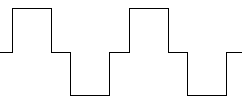
A modified sine wave inverter actually has a waveform more like a square wave, but with an extra step or so. A lot of equipment will work well on modified sine wave inverters, including motors, household appliances and other items. Some types of loads can be problematic and do require a pure sine wave converter.
3. Square Wave
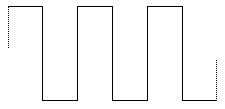
A square wave is very simple, with the d.c. supply switched between positive and negative. There are very few, but the cheapest inverters are square waves. A square wave inverter will run simple things like tools with universal motors without a problem, but not much else.
Steps for DC-to-AC Conversion
The block diagram illustrates the key components of a DC-to-AC Converters or Inverter.

1. Input Filter – the input filter removes any ripple or frequency disturbances on the d.c. supply, to provide a clean voltage to the inverter circuit.
2. Inverter – this is the main power circuit. It is here that the d.c. is converted into a multilevel PWM waveform.
3.Output Filter – the output filter removes the high-frequency components of the PWM wave, to produce a nearly sinusoidal output.
Inverters are complex devices, but they are able to convert DC-to-AC for general power supply use. Inverters allow us to tap into the simplicity of DC systems and utilize equipment designed to work in a conventional AC environment.
Pulse Width Modulation
The most commonly used technique in inverters is called Pulse Width Modulation (PWM). PWM is used to turn the DC voltage on and off with a certain pulse. The width of each pulse is varied so that the overall electrical result is similar to that of a sine wave.

This is a PWM waveform for a standard inverter. Here a single DC voltage is switched on or off to generate the desired output. More input DC voltage levels are used to create an output waveform that more closely resembles a sine wave.

The PWM waveforms are not sinusoidal & harmonics will be generated. Thus, more levels are employed, the closer the output will approximate a sine wave and the harmonic content will be lower. To filter the PWM waveform and reduce the harmonic content, Inverters employ the use of transformers, capacitors, and inductors.
H-Bridge Circuit
Most of the inverter consists of simple H-Bridge arrangement. The circuit is an implementation of a single-phase H-Bridge circuit using Insulated Gate Bipolar Transistors (IGBT).

The IGBT act as a switch in the above circuit. When a signal is applied to the gate, they turn on and when the signal is removed they turn off. By closing Q1 and Q4, a positive DC supply is applied to the load. The Q2 and Q3 will result in a negative DC supply across the load. Then the control circuits are used to generate the necessary gate signals to produce the required PWM waveform.
It is necessary to avoid short circuits. This happens by closing both Q1 and Q2 at the same time. To avoid this, it is necessary to turn off one set of IGBT before turning on the next. The Diodes provide a necessary path for inductive current in order to limit potential voltage build-up during the transition period. The capacitor provides smoothing to even out any variation in the DC supply.
Limitations of DC-to-AC Converters (Inverters)
- The circuit efficiency can be reduced by the usage of the transistor.
- Cross-over distortion within the o/p signal can be caused by the usage of switching transistors. We can reduce this limit to some level by using biasing diodes.
Applications
DC-to-AC converters, also known as inverters, play a crucial role in many different applications due to their ability to convert direct current (DC) to alternating current (AC). Here are several important uses for these devices:
- Solar Power Systems: The photovoltaic cells in solar panels generate DC electricity. Inverters convert this DC power into AC power, which can be used directly in homes or fed back into the grid.
- Uninterruptible Power Supplies (UPS): In a UPS system, the battery stores power as DC. If the main power supply fails, the UPS uses an inverter to convert the DC power from the battery into AC power, ensuring a continuous supply to critical equipment such as computers, data centers, and hospitals.
- Electric Vehicles: The battery in an electric vehicle (EV) provides DC power. An inverter is used to convert this to AC power to run the AC motors that propel the vehicle.
- Power Generation Systems: In power plants that use fuel cells, batteries, or other types of generators that produce DC power, inverters are necessary to convert this DC power into AC power for distribution.
- Home Appliances: Many devices such as laptops, cameras, and smartphones use DC power, but the power from the wall outlet is AC. The power adapters for these devices include an AC-to-DC converter. If you’re using a device powered by a DC source (like a battery) and want to plug it into a wall outlet, you’ll need a DC-to-AC inverter.
- Air Travel: Aircraft often generate DC power, but the onboard electronics, lighting, and other systems typically run on AC power. Inverters are used to make this conversion.
- Variable Frequency Drives: In industries, inverters are used in variable frequency drives (VFDs) to vary the frequency and voltage supplied to an AC motor, allowing for precise speed and torque control.
- HVDC Systems: High Voltage Direct Current (HVDC) transmission systems use inverters to convert DC back to AC at the receiving end.
- Portable Generators and Power Stations: Portable generators and power stations often use batteries (DC) as their energy source. An inverter is needed to convert that DC power into usable AC power for devices like lights, refrigerators, or power tools.
These are just a few of the many applications of inverters in modern technology. As our reliance on electrical power continues to grow, so too does the importance of these versatile devices.
Some of the Inverters we designed for our project can be followed here:




3 Comments
I am glad to see such good information Dc to Ac converter projects.
This article is full of nonsense and should be reviewed.
The DC-to-AC Converters are used to charge the batteries in the vehicles. – Vehicles don’t run on AC.
Cross-over distortion within the o/p signal can be caused by the usage of switching transistors – Not true in practice.
You are wrong. The battery in an electric vehicle (EV) provides DC power. An inverter is used to convert this to AC power to run the AC motors that propel the vehicle.