Close Menu
  • Articles
    • Learn Electronics
    • Product Review
    • Tech Articles
  • Electronics Circuits
    • 555 Timer Projects
    • Op-Amp Circuits
    • Power Electronics
  • Microcontrollers
    • Arduino Projects
    • STM32 Projects
    • AMB82-Mini IoT AI Camera
    • BLE Projects
  • IoT Projects
    • ESP8266 Projects
    • ESP32 Projects
    • ESP32 MicroPython
    • ESP32-CAM Projects
    • LoRa/LoRaWAN Projects
  • Raspberry Pi
    • Raspberry Pi Projects
    • Raspberry Pi Pico Projects
    • Raspberry Pi Pico W Projects
  • Electronics Calculator
Facebook X (Twitter) Instagram
  • About Us
  • Disclaimer
  • Privacy Policy
  • Contact Us
  • Advertise With Us
Facebook X (Twitter) Instagram Pinterest YouTube LinkedIn
How To Electronics
  • Articles
    • Learn Electronics
    • Product Review
    • Tech Articles
  • Electronics Circuits
    • 555 Timer Projects
    • Op-Amp Circuits
    • Power Electronics
  • Microcontrollers
    • Arduino Projects
    • STM32 Projects
    • AMB82-Mini IoT AI Camera
    • BLE Projects
  • IoT Projects
    • ESP8266 Projects
    • ESP32 Projects
    • ESP32 MicroPython
    • ESP32-CAM Projects
    • LoRa/LoRaWAN Projects
  • Raspberry Pi
    • Raspberry Pi Projects
    • Raspberry Pi Pico Projects
    • Raspberry Pi Pico W Projects
  • Electronics Calculator
How To Electronics
Home » Interfacing 5MP SPI Camera with NodeMCU ESP8266
ESP8266 Projects

Interfacing 5MP SPI Camera with NodeMCU ESP8266

Mamtaz AlamBy Mamtaz AlamUpdated:May 28, 20232 Comments5 Mins Read
Share Facebook Twitter LinkedIn Telegram Reddit WhatsApp
Interfacing 5MP SPI Camera with NodeMCU ESP8266
Share
Facebook Twitter LinkedIn Pinterest Email Reddit Telegram WhatsApp

Overview

This tutorial is about Arducam Mega Camera, as we will be interfacing this 5MP SPI Camera with NodeMCU ESP8266 WiFi Module. Recently Arducam launched a legendary camera solution that helps you connect one or more cameras to any microcontroller without the least effort. It is particularly targeted for battery-powered IoT devices, embedded machine vision, and artificial intelligence applications. Arducam Mega Camera can work with any microcontroller with a single standard SPI interface. No memory is required for register settings or frame buffers. The best part is it is fully compatible with 3.3V and 5V systems.

In this project we will interface 5-megapixel Arducam Mega Camera with NodeMCU ESP8266 Board and do the various operations including image capturing with various pixel resolutions. We will also stream some videos only with the help of the ESP8266 Board. Arducam has released Arducam Mega SDK for Arducam Mega camera which makes the programming very simple. So, let’s go through this camera & its operations in detail.


Arducam Mega Camera

The Arducam Mega Camera is a legendary camera solution that helps you connect one or more cameras to any microcontroller without or the least effort. It is basically targeted for battery-powered IoT devices, embedded machine vision, and artificial intelligence applications.

Arducam Mega SPI Camera

Arducam Mega can work with any microcontroller with a single standard SPI interface. Only 4 pins (GPIOs) are required excluding VCC & GND. No memory is required for register settings or frame buffers. It is fully compatible with 3.3V & 5V systems. The camera can be directly used with Arduino, STM8/STM32, ESP8266/ESP32, MSP430, Nordic, Renesas & other MCU systems.

The camera is specially designed for energy-saving applications. You can completely switch off the camera when your MCU is sleeping, without worrying about loading long register settings, as it does for you instantly (less than 100 ms) and automatically. There are two versions of Arducam Mega cameras, one with 3MP(fixed focus) and the other with 5MP(autofocus). It comes with a default enclosure, you can mount it easily wherever you want.

Arducam Mega Camera

The detail of this Camera is explained in the previous post. You can follow the Arducam Getting Started guide to learn each and every detail about this Camera.


Interfacing 5MP Arducam Mega Camera with NodeMCU ESP8266

Now let us see how we can interface 5 megapixel SPI Camera called Arducam Mega with NodeMCU ESP8266. The connection diagram is fairly simple as shown in the image below.

Following is the connection between NodeMCU ESP8266 Board & 5MP Arducam Mega Camera.

Camera Pin NodeMCU ESP8266 Board
VCC 3.3V
GND GND
SCK D5
MISO D6
MOSI D7
CS D0

You can directly connect the Camera with NodeMCU ESP8266 Board using the jumper wires.

NodeMCU ESP8266 Camera


Arducam Mega Library Installation

The Arducam has released the library for ESP8266 Boards & other microcontrollers. The environment configuration and use is based on Arduino IDE.

Library Link: https://github.com/ArduCAM/Arducam_Mega.git

Downloaded the library file & copy the extracted folder to the Arduino library folder.


Source Code/Program

After the library is added to the Arduino Library folder, you can use the example code from the library example to test the Camera.
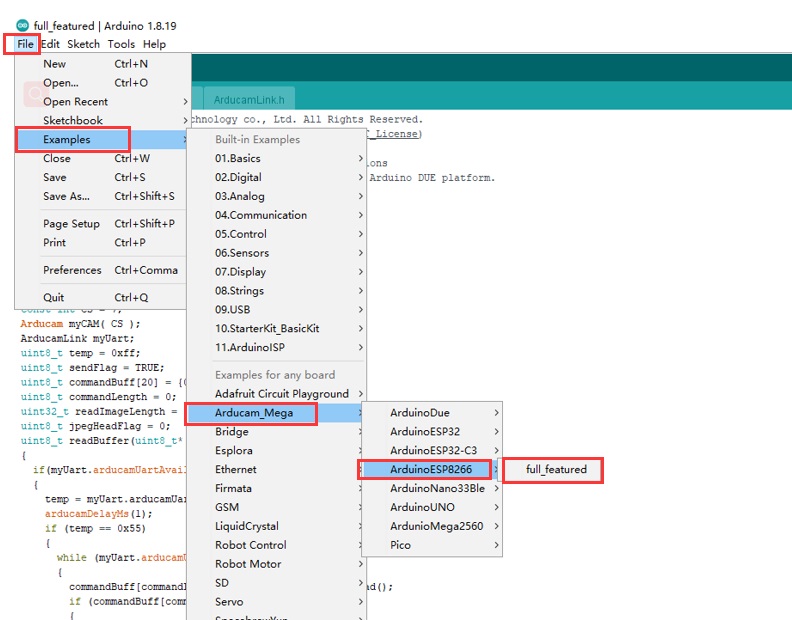
We will use an example called full_featured to test the camera.
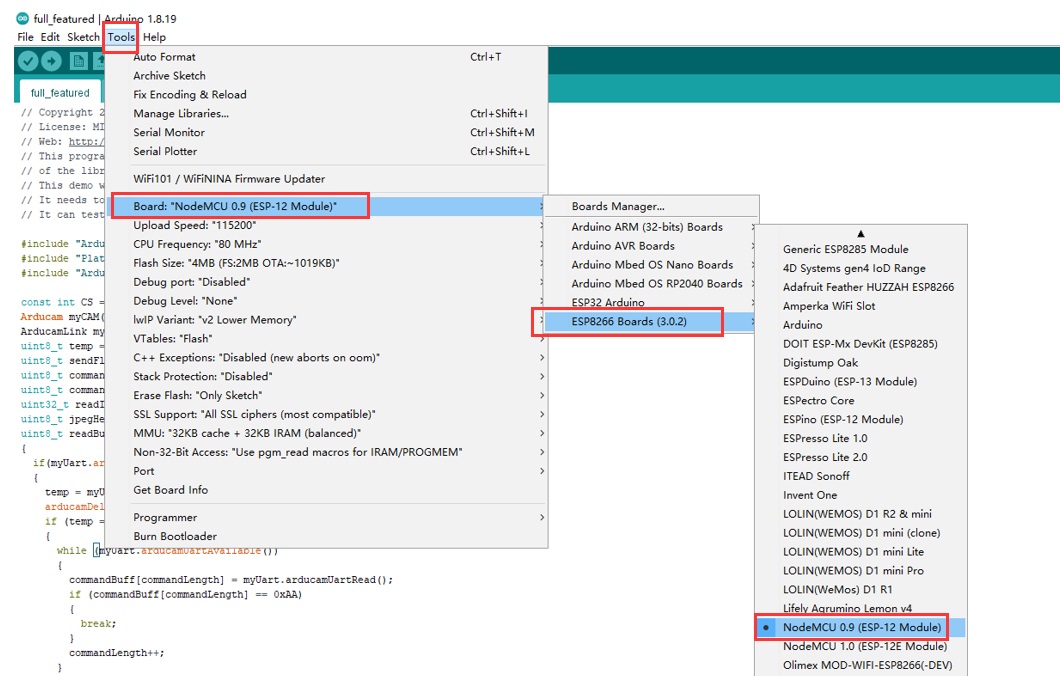
After selecting the example, select the NodeMCU 1.0 Board from the Board list & then click on the upload button to upload the code to the Arduino UNO Board.


Testing the Camera

To test the Camera working we need some GUI visulization software. So download the Arducam software from the following link.

https://github.com/ArduCAM/Arducam_Mega/releases/download/v1.0.0/ArducamMegaSetup_Windows_x64.exe

After downloading, install the software on your computer.

After installation, Select the NodeMCU ESP8266 port number, the baud rate is 921600, and click open.

Now the Camera gets connected to the visualization software. Therefore you can move the camera in different directions to see everything on GUI Screen.

ESP8266 Camera Visualization

You can click the image button to take a photo. You can click the close button to close the display window. You can also select the resolution & format.

Click the Video button to enable video streaming mode, the default resolution is 320X240. Click the close button to disable video streaming mode.


The auto exposure is enabled by default. When using manual exposure, you need to turn off the automatic exposure function.

The auto gain is enabled by default. When using manual gain, you need to turn off the automatic gain function.

The software has a feature for brightness control, contrast control, EV control, saturation control, special effects control, white balance control, and focus control.

The autofocus control is available on the 5MP Arducam Mega Camera. You can enable or disable this feature. Enable or disable the continuous focus function, the default is to disable the continuous focus function.

Parameter Function
Open Enable the focus function
SingleTime Enable single focus
Persistent Enable continuous focus
Stop Pause autofocus
Close Turn off focus

That’s all from this tutorial. This camera has the ability to empower the future of IoT as this is the best camera solution for any MCU-based, low-power IoT and embedded vision applications/systems.


Video Tutorial & Guide

Arducam Mega Camera || The Ultimate Camera for Arduino, ESP8266 & ESP32
Watch this video on YouTube.

Share. Facebook Twitter Pinterest LinkedIn Tumblr Email Reddit Telegram WhatsApp
Previous ArticleArducam | Interfacing 5MP SPI Camera with Arduino UNO
Next Article Interfacing 5MP SPI Camera with ESP32 WiFi Module

Related Posts

Humidity & Temperature Monitoring using DHT11 & NodeMCU on ThingSpeak

ESP8266 & DHT11 Humidity Temperature Monitor on ThingSpeak

Updated:October 19, 20253443K
Water Tank Level Monitoring System with GSM & ESP8266

Monitor Water Tank Level with GSM & ESP8266 on Blynk

Updated:June 28, 20255K
IoT-enabled Smart Fridge with ESP8266 & DS18B20

IoT-enabled Smart Fridge with ESP8266 WebServer

Updated:February 2, 202525K
How to Flash or Upgrade Firmware on ESP8266 (ESP-01)

How to Flash or Upgrade Firmware on ESP8266 (ESP-01)

Updated:February 2, 202514K
IoT Based Patient Health Monitoring System using ESP8266 & Arduino

IoT Patient Health Monitoring with ESP8266 & Arduino

Updated:February 2, 2025156K
IoT Solar Panel Monitoring System with ESP8266 & MQTT

IoT Solar Panel Monitoring System with ESP8266 & MQTT

Updated:February 2, 202518K
View 2 Comments

2 Comments

  1. John iweh on November 29, 2022 12:34 AM

    Can this camera be streamed wirelessly

    Reply
  2. Atta Ullah Shah bukhari on December 1, 2022 9:54 PM

    Please sir send me it’s code

    Reply

CommentsCancel reply

Latest Posts
IoT Based PM & Air Quality Monitoring System using ESP32

IoT Based PM & Air Quality Monitoring System using ESP32

May 31, 2026
DIY ESP32 MLX90640 IR Thermal Camera with Live Web Display

DIY ESP32 MLX90640 IR Thermal Camera with Live Web Display

May 10, 2026
IoT Activity Tracker with ESP32 & Accelerometer Gyroscope

IoT Activity Tracker with ESP32 & Accelerometer/Gyroscope

May 2, 2026
A Guide to Sourcing Obsolete ICs for Vintage Projects

Beyond AliExpress: A Guide to Sourcing Obsolete ICs for Vintage Projects

April 21, 2026

ESP32 IoT Vehicle Motion Analyzer with MPU6050 & LIS3MDL

April 27, 2026
Building a Smart Sensor Node with a BLE Microcontroller

Building a Smart Sensor Node with a BLE Microcontroller

February 26, 2026
High-Accuracy Pitch, Roll, Yaw with ESP32 & BNO08x IMU

High-Accuracy Pitch, Roll, Yaw with ESP32 & BNO08x IMU

April 27, 2026
DIY Colorimeter using AS7265x Spectroscopy Sensor & ESP32

DIY Colorimeter using AS7265x Spectroscopy Sensor & ESP32

February 1, 2026
Top Posts & Pages
  • IoT Based PM & Air Quality Monitoring System using ESP32
    IoT Based PM & Air Quality Monitoring System using ESP32
  • 12V DC to 220V AC Inverter Circuit & PCB
    12V DC to 220V AC Inverter Circuit & PCB
  • IoT AC Energy Meter with PZEM-004T & ESP32 WebServer
    IoT AC Energy Meter with PZEM-004T & ESP32 WebServer
  • Buck Converter: Basics, Working, Design & Application
    Buck Converter: Basics, Working, Design & Application
  • LD2410 Sensor with ESP32 - Human Presence Detection
    LD2410 Sensor with ESP32 - Human Presence Detection
  • ECG Graph Monitoring with AD8232 ECG Sensor & Arduino
    ECG Graph Monitoring with AD8232 ECG Sensor & Arduino
  • ESP32 CAN Bus Tutorial | Interfacing MCP2515 CAN Module with ESP32
    ESP32 CAN Bus Tutorial | Interfacing MCP2515 CAN Module with ESP32
  • L293D Dual H-Bridge Motor Driver IC Pins, Circuit, Working
    L293D Dual H-Bridge Motor Driver IC Pins, Circuit, Working
Categories
  • Arduino Projects (197)
  • Articles (60)
    • Learn Electronics (19)
    • Product Review (15)
    • Tech Articles (28)
  • Electronics Circuits (46)
    • 555 Timer Projects (21)
    • Op-Amp Circuits (7)
    • Power Electronics (13)
  • IoT Projects (204)
    • ESP32 MicroPython (7)
    • ESP32 Projects (81)
    • ESP32-CAM Projects (15)
    • ESP8266 Projects (76)
    • LoRa/LoRaWAN Projects (22)
  • Microcontrollers (38)
    • AMB82-Mini IoT AI Camera (4)
    • BLE Projects (18)
    • STM32 Projects (19)
  • Raspberry Pi (93)
    • Raspberry Pi Pico Projects (57)
    • Raspberry Pi Pico W Projects (12)
    • Raspberry Pi Projects (24)
Follow Us
  • Facebook
  • Twitter
  • Pinterest
  • Instagram
  • YouTube
About Us

“‘How to Electronics’ is a vibrant community for electronics enthusiasts and professionals. We deliver latest insights in areas such as Embedded Systems, Power Electronics, AI, IoT, and Robotics. Our goal is to stimulate innovation and provide practical solutions for students, organizations, and industries. Join us to transform learning into a joyful journey of discovery and innovation.

Copyright © How To Electronics. All rights reserved.
  • About Us
  • Disclaimer
  • Privacy Policy
  • Contact Us
  • Advertise With Us

Type above and press Enter to search. Press Esc to cancel.

Ad Blocker Enabled!
Ad Blocker Enabled!
Looks like you're using an ad blocker. Please allow ads on our site. We rely on advertising to help fund our site.