Close Menu
  • Articles
    • Learn Electronics
    • Product Review
    • Tech Articles
  • Electronics Circuits
    • 555 Timer Projects
    • Op-Amp Circuits
    • Power Electronics
  • Microcontrollers
    • Arduino Projects
    • STM32 Projects
    • AMB82-Mini IoT AI Camera
    • BLE Projects
  • IoT Projects
    • ESP8266 Projects
    • ESP32 Projects
    • ESP32 MicroPython
    • ESP32-CAM Projects
    • LoRa/LoRaWAN Projects
  • Raspberry Pi
    • Raspberry Pi Projects
    • Raspberry Pi Pico Projects
    • Raspberry Pi Pico W Projects
  • Electronics Calculator
Facebook X (Twitter) Instagram
  • About Us
  • Disclaimer
  • Privacy Policy
  • Contact Us
  • Advertise With Us
Facebook X (Twitter) Instagram Pinterest YouTube LinkedIn
How To Electronics
  • Articles
    • Learn Electronics
    • Product Review
    • Tech Articles
  • Electronics Circuits
    • 555 Timer Projects
    • Op-Amp Circuits
    • Power Electronics
  • Microcontrollers
    • Arduino Projects
    • STM32 Projects
    • AMB82-Mini IoT AI Camera
    • BLE Projects
  • IoT Projects
    • ESP8266 Projects
    • ESP32 Projects
    • ESP32 MicroPython
    • ESP32-CAM Projects
    • LoRa/LoRaWAN Projects
  • Raspberry Pi
    • Raspberry Pi Projects
    • Raspberry Pi Pico Projects
    • Raspberry Pi Pico W Projects
  • Electronics Calculator
How To Electronics
Home » DC-to-DC Converters: Design, Working & Applications
Articles Learn Electronics

DC-to-DC Converters: Design, Working & Applications

Daman ShahBy Daman ShahUpdated:May 20, 20231 Comment5 Mins Read
Share Facebook Twitter LinkedIn Telegram Reddit WhatsApp
DC-to-DC Converters
Share
Facebook Twitter LinkedIn Pinterest Email Reddit Telegram WhatsApp

What is a DC-to-DC Converters?

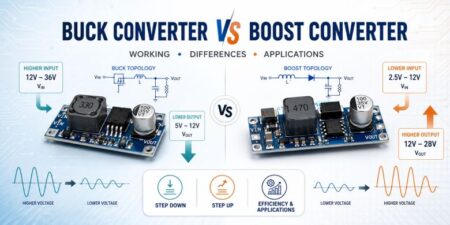
The DC-to-DC converters convert one level of DC voltage to another level. The operating voltage of different electronic devices such as ICs, MOSFET can vary over a wide range, making it necessary to provide a voltage for each device. A Buck Converter outputs a lower voltage than the original voltage, while a Boost Converter supplies a higher voltage.

With the application of DC-to-DC Converters, the circuit’s efficiency, ripple, and load-transient response can be changed. Optimal external parts and components are generally dependent on operating conditions such as input and output specifications. So, while designing the products, the standard circuits must be varied or changed according to and as per the need to their individual specification requirements. Designing the circuit that satisfies the specification and all the requirements needs a great deal of expertise and experience in that field.


The step-up or step-down DC-to-DC Converters are useful in applications where the battery voltage can be above or below the regulator output voltage. The DC to DC converter must be able to operate as a step up or down voltage supplier to provide constant load voltage over the entire battery voltage range through the operation.


Working Principle of DC-DC converter

The working principle of the DC-to-DC converter is very simple. The inductor in the input resistance has an unexpected variation in the input current. If the switch is kept as high (on), then the inductor feeds the energy from the input and stores the energy in the form of magnetic energy.

DC-to-DC Converters Working Principle

If the switch is kept as low (off), it discharges the energy. Here, the output of the capacitor is assumed as high that is sufficient for the time constant of an RC circuit on the output side. The huge time constant is compared with the switching period and made sure that the steady-state is a constant output voltage. It should be Vo(t) = Vo(constant) and present at the load terminal.


Types of DC-to-DC Converters

1: Magnetic Converters

In these DC-to-DC Converters, energy is periodically stored and released from a magnetic field in an inductor or a transformer. The frequency ranges from 300 kHz to 10MHz. By maintaining the duty cycle of the charging voltage the amount of power that needs to be transferred continuously to a load can be more easily controlled.

Moreover, the control can also be applied to the input current, the output current or to maintain constant power through the circuit. The transformer-based converter can easily provide the isolation between input and output.

2: Non-Isolated Converters

Non-isolated converters are mostly used when the change in the voltage is comparatively small. It posses the input and output terminal to a common ground. The major disadvantage is that it cannot provide protection from high electrical voltages and it poses more noise.


3: Step-down/Buck Converters

In a typical non-isolated step-down or buck converter the output voltage VOUT depends on the input voltage VIN and the switching duty cycle D of the power switch.

Step-down Buck Converters

4: Step-up/Boost Converters

It is used to boost DC to DC converter voltage and it uses the same number of passive components but arranged to step up the input voltage so that the output is higher than that of the input.

Step-up Boost Converters

5: Buck-Boost Converters

This converter allows the input DC voltage to be either stepped-up or stepped-down, depending on the duty cycle.

Buck Boost Converter

The output voltage is given by the relation as mentioned below:

C++
1
VOUT = -VIN *D/ (1-D)

From the above expression, we can notice that the output voltage is always reversed in polarity with respect to the input. Therefore, a buck-boost converter is also known as a voltage inverter.

6: Isolated Converters

The Isolated converter has a separation between its input and output terminals. They have high isolation voltage properties. They can block the noise and interference. With this, they are able to produce a cleaner and desired DC output voltage. They are further categorized into two types.

I: Flyback converters

The working of this converter is similar to the buck-boost converter of the non-isolating category. The only difference is that it uses a transformer to store energy instead of an inductor in the circuit.

II: Forward Converters

The working of this converter makes use of the transformer to send the energy, between the input and output in a single step.


Advantages & Disadvantages of DC-to-DC Converters

Advantages

• It simplifies the power supply systems in the circuit.
• It provides isolation in the primary and secondary circuits from each other.
• It provides a technique to extend potential (voltage) as required.
• It is available as a hybrid circuit with all elements in a single chip.
• It is also used in the regulation and control of DC voltage.
• The output is well organized as positive or negative.
• Battery space can be reduced by using a converter.

Disadvantages

• Switching converters lead to more noise.
• They are expensive as an external circuit is required.
• Choppers are inadequate due to unsteady voltage and current supply.
• More ripple current, More input and output capacitance, higher losses, etc.

Check out some practical example circuits related to Buck & Boost DC-to-DC Converters.
  1. 3.7V to 9V Boost Converter Circuit

  2. 3.7V to 5V Boost Converter Circuit

  3. 7V-35V DC-to-DC Converter Circuit

  4. 12V to 24V Voltage Doubler Circuit

Share. Facebook Twitter Pinterest LinkedIn Tumblr Email Reddit Telegram WhatsApp
Previous ArticleAC to DC Converters: Features, Design & Applications
Next Article DIY Surveillance CCTV Camera using ESP32 CAM & Blynk

Related Posts

A Guide to Sourcing Obsolete ICs for Vintage Projects

Beyond AliExpress: A Guide to Sourcing Obsolete ICs for Vintage Projects

Speed-Run Translations: Making Fast-Moving Meme Videos Accessible Worldwide

The Future of Video Production: Adding Emotion with AI Voice Generators

Updated:August 26, 2025
A Beginner’s Guide to Building Compact Electronic Circuits at Home

A Beginner’s Guide to Building Compact Electronic Circuits at Home

Updated:August 5, 2025
Why DIY IoT Prototype Fails at Scale Hidden Component‑Sourcing Trap

Why DIY IoT Prototype Fails at Scale: Hidden Component‑Sourcing Trap

Microchip ATECC608A CryptoAuthentication Devices

Securing IoT Devices With Microchip ATECC608A

View 1 Comment

1 Comment

  1. abhishake on May 4, 2022 3:25 PM

    can u provide Dc to Dc buck converter schematic and also testbench values for 1.8 to 0.9 or else any other inputs u can take sir , we pay the charges,

    Reply

CommentsCancel reply

Latest Posts
ESP32 Fingerprint Attendance System with Live Web Dashboard

ESP32 Fingerprint Attendance System with Live Web Dashboard

June 21, 2026
IoT Based PM & Air Quality Monitoring System using ESP32

IoT Based PM & Air Quality Monitoring System using ESP32

June 14, 2026
DIY ESP32 MLX90640 IR Thermal Camera with Live Web Display

DIY ESP32 MLX90640 IR Thermal Camera with Live Web Display

May 10, 2026
IoT Activity Tracker with ESP32 & Accelerometer Gyroscope

IoT Activity Tracker with ESP32 & Accelerometer/Gyroscope

May 2, 2026
A Guide to Sourcing Obsolete ICs for Vintage Projects

Beyond AliExpress: A Guide to Sourcing Obsolete ICs for Vintage Projects

April 21, 2026

ESP32 IoT Vehicle Motion Analyzer with MPU6050 & LIS3MDL

April 27, 2026
Building a Smart Sensor Node with a BLE Microcontroller

Building a Smart Sensor Node with a BLE Microcontroller

February 26, 2026
High-Accuracy Pitch, Roll, Yaw with ESP32 & BNO08x IMU

High-Accuracy Pitch, Roll, Yaw with ESP32 & BNO08x IMU

April 27, 2026
Top Posts & Pages
  • ESP32 Fingerprint Attendance System with Live Web Dashboard
    ESP32 Fingerprint Attendance System with Live Web Dashboard
  • IoT AC Energy Meter with PZEM-004T & ESP32 WebServer
    IoT AC Energy Meter with PZEM-004T & ESP32 WebServer
  • 12V DC to 220V AC Inverter Circuit & PCB
    12V DC to 220V AC Inverter Circuit & PCB
  • ESP32 CAN Bus Tutorial | Interfacing MCP2515 CAN Module with ESP32
    ESP32 CAN Bus Tutorial | Interfacing MCP2515 CAN Module with ESP32
  • IoT Based ECG Monitoring with AD8232 ECG Sensor & ESP32
    IoT Based ECG Monitoring with AD8232 ECG Sensor & ESP32
  • How to use Modbus RTU with ESP32 to read Sensor Data
    How to use Modbus RTU with ESP32 to read Sensor Data
  • Half Wave Rectifier Basics, Circuit, Working & Applications
    Half Wave Rectifier Basics, Circuit, Working & Applications
  • How to use INA226 DC Current Sensor with Arduino
    How to use INA226 DC Current Sensor with Arduino
Categories
  • Arduino Projects (197)
  • Articles (60)
    • Learn Electronics (19)
    • Product Review (15)
    • Tech Articles (28)
  • Electronics Circuits (46)
    • 555 Timer Projects (21)
    • Op-Amp Circuits (7)
    • Power Electronics (13)
  • IoT Projects (205)
    • ESP32 MicroPython (7)
    • ESP32 Projects (82)
    • ESP32-CAM Projects (15)
    • ESP8266 Projects (76)
    • LoRa/LoRaWAN Projects (22)
  • Microcontrollers (38)
    • AMB82-Mini IoT AI Camera (4)
    • BLE Projects (18)
    • STM32 Projects (19)
  • Raspberry Pi (93)
    • Raspberry Pi Pico Projects (57)
    • Raspberry Pi Pico W Projects (12)
    • Raspberry Pi Projects (24)
Follow Us
  • Facebook
  • Twitter
  • Pinterest
  • Instagram
  • YouTube
About Us

“‘How to Electronics’ is a vibrant community for electronics enthusiasts and professionals. We deliver latest insights in areas such as Embedded Systems, Power Electronics, AI, IoT, and Robotics. Our goal is to stimulate innovation and provide practical solutions for students, organizations, and industries. Join us to transform learning into a joyful journey of discovery and innovation.

Copyright © How To Electronics. All rights reserved.
  • About Us
  • Disclaimer
  • Privacy Policy
  • Contact Us
  • Advertise With Us

Type above and press Enter to search. Press Esc to cancel.

Ad Blocker Enabled!
Ad Blocker Enabled!
Looks like you're using an ad blocker. Please allow ads on our site. We rely on advertising to help fund our site.