Close Menu
  • Articles
    • Learn Electronics
    • Product Review
    • Tech Articles
  • Electronics Circuits
    • 555 Timer Projects
    • Op-Amp Circuits
    • Power Electronics
  • Microcontrollers
    • Arduino Projects
    • STM32 Projects
    • AMB82-Mini IoT AI Camera
    • BLE Projects
  • IoT Projects
    • ESP8266 Projects
    • ESP32 Projects
    • ESP32 MicroPython
    • ESP32-CAM Projects
    • LoRa/LoRaWAN Projects
  • Raspberry Pi
    • Raspberry Pi Projects
    • Raspberry Pi Pico Projects
    • Raspberry Pi Pico W Projects
  • Electronics Calculator
Facebook X (Twitter) Instagram
  • About Us
  • Disclaimer
  • Privacy Policy
  • Contact Us
  • Advertise With Us
Facebook X (Twitter) Instagram Pinterest YouTube LinkedIn
How To Electronics
  • Articles
    • Learn Electronics
    • Product Review
    • Tech Articles
  • Electronics Circuits
    • 555 Timer Projects
    • Op-Amp Circuits
    • Power Electronics
  • Microcontrollers
    • Arduino Projects
    • STM32 Projects
    • AMB82-Mini IoT AI Camera
    • BLE Projects
  • IoT Projects
    • ESP8266 Projects
    • ESP32 Projects
    • ESP32 MicroPython
    • ESP32-CAM Projects
    • LoRa/LoRaWAN Projects
  • Raspberry Pi
    • Raspberry Pi Projects
    • Raspberry Pi Pico Projects
    • Raspberry Pi Pico W Projects
  • Electronics Calculator
How To Electronics
Home » AC to DC Converters: Features, Design & Applications
Articles Learn Electronics

AC to DC Converters: Features, Design & Applications

Mamtaz AlamBy Mamtaz AlamUpdated:May 20, 20234 Mins Read
Share Facebook Twitter LinkedIn Telegram Reddit WhatsApp
AC to DC Converters
Share
Facebook Twitter LinkedIn Pinterest Email Reddit Telegram WhatsApp

AC to DC Converters

AC to DC Converters are one of the most important elements in power electronics. This is because there are a lot of real-life applications that are based on these conversions. The electrical circuits that transform alternating current (AC) input into direct current (DC) output are known as AC-DC converters. They are used in power electronic applications where the power input a 50 Hz or 60 Hz sine-wave AC voltage that requires power conversion for a DC output.

The process of conversion of AC current to dc current is known as rectification. The rectifier converts the AC supply into the DC supply at the load end connection. Similarly, transformers are normally used to adjust the AC source to reduce the voltage level to have a better operation range for DC supply.


Concept of Alternating current (AC) & Direct current (DC)

Alternating Current

In alternating current, the current changes direction and flows forward and backward. The current whose direction changes periodically is called an alternating current (AC). It has non-zero frequency. It is produced by AC generator, dynamo, etc.

Simple AC Circuit
Fig: Simple AC Circuit

Direct Current

In direct current, the current doesn’t change its magnitude and polarity. If the current always flows in the same direction in a conductor then it is called direct current. It has zero frequency. It is produced by cells, battery, DC generator etc.

Simple DC Circuit
Fig: Simple DC Circuit

Simple Steps to change AC into DC

Now us discuss about AC to DC converter. Let us consider frequently used converter in the power supply circuit, 230V AC to 5V DC converter.

1. Stepping down the Voltage Levels

Sometimes voltages need to be increased while sending power to long distances. Similarly, voltages need to be decreased for equipment that uses the lower power. The step-up transformers are being used for stepping up the voltage levels and step-down transformers are being used for stepping down the voltage levels.

Consider a transformer with 12V Output. The 230V AC power supply is converted into 12V AC by using step down transformer. RMS value and its peak value can be given by the product of the square root of two and RMS value and is approximately equal to 17V which is the output of the step-down transformer.


2. AC to DC Power Converter Circuit

The rectifier converts the AC supply into the DC supply at the load end connection. There are different types of rectifiers, such as half-wave, full-wave, and bridge rectifiers.

AC to DC Converter Circuit

Full Bridge rectifier which consists of four diodes are connected in the form of a bridge. The diode conducts only in one direction, i.e during forward bias. It remains in an off state in another direction, i.e. during reverse bias.

In the above circuit, during the positive half cycle, the diodes D2 & D4 conducts. And during the negative half cycle of the power supply, diodes D1 & D3 conducts. Thus, in this way input AC power is rectified into output DC power. But the problem is DC output power consists of pulses and is not pure DC.

3. Obtaining Pure DC Waveform

We need to convert the pulsating DC to pure DC. To do that, most of the circuit uses a Capacitors. The capacitor is used to store energy while the input voltage is increasing from zero to its peak value. The energy from the capacitor can be discharged while the input voltage is decreasing from its peak value to zero.

Thus, In this way, we can convert the pulsating DC into pure DC using this charging & discharging process of the capacitor.


4. Regulating Fixed DC Voltage

In order to fix the output voltage to the fixed desired value, we finally use the voltage regulator IC. The DC voltage regulators IC comes with the name 78XX. The last two digits XX-represents the output voltage value. For example, to limit the output voltage to 5V, we use the 7805 Voltage Regulator IC. And to limit the voltage to 9V, we use a 7809 Voltage regulator IC.


Applications

The AC to DC Converters are used in almost all electronics and electrical devices. They are used as power supply circuits for Household applications like vacuum cleaners, washing machines, refrigerators, electric rice cookers. For daily life, usable products like computers, televisions, cell phone chargers, etc AC-to-DC Converters play a very important role.

Most of the electronics sensors and modules only operate on DC supply and hence they use AC to DC Converters. They are also used in medical equipment, factory automation, building automation, process control systems, signage displays & telecommunication.

The other applications of AC to DC Converters are in renewable energy management, test & measuring equipment, defense, aerospace, and transportation systems.

Share. Facebook Twitter Pinterest LinkedIn Tumblr Email Reddit Telegram WhatsApp
Previous Article555 Timer IC – Features, Pinout, Working, Circuit, Operating Modes
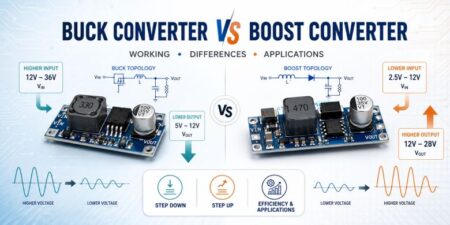
Next Article DC-to-DC Converters: Design, Working & Applications

Related Posts

A Guide to Sourcing Obsolete ICs for Vintage Projects

Beyond AliExpress: A Guide to Sourcing Obsolete ICs for Vintage Projects

Speed-Run Translations: Making Fast-Moving Meme Videos Accessible Worldwide

The Future of Video Production: Adding Emotion with AI Voice Generators

Updated:August 26, 2025
A Beginner’s Guide to Building Compact Electronic Circuits at Home

A Beginner’s Guide to Building Compact Electronic Circuits at Home

Updated:August 5, 2025
Why DIY IoT Prototype Fails at Scale Hidden Component‑Sourcing Trap

Why DIY IoT Prototype Fails at Scale: Hidden Component‑Sourcing Trap

Microchip ATECC608A CryptoAuthentication Devices

Securing IoT Devices With Microchip ATECC608A

Add A Comment

CommentsCancel reply

Latest Posts
ESP32 Fingerprint Attendance System with Live Web Dashboard

ESP32 Fingerprint Attendance System with Live Web Dashboard

June 16, 2026
IoT Based PM & Air Quality Monitoring System using ESP32

IoT Based PM & Air Quality Monitoring System using ESP32

June 14, 2026
DIY ESP32 MLX90640 IR Thermal Camera with Live Web Display

DIY ESP32 MLX90640 IR Thermal Camera with Live Web Display

May 10, 2026
IoT Activity Tracker with ESP32 & Accelerometer Gyroscope

IoT Activity Tracker with ESP32 & Accelerometer/Gyroscope

May 2, 2026
A Guide to Sourcing Obsolete ICs for Vintage Projects

Beyond AliExpress: A Guide to Sourcing Obsolete ICs for Vintage Projects

April 21, 2026

ESP32 IoT Vehicle Motion Analyzer with MPU6050 & LIS3MDL

April 27, 2026
Building a Smart Sensor Node with a BLE Microcontroller

Building a Smart Sensor Node with a BLE Microcontroller

February 26, 2026
High-Accuracy Pitch, Roll, Yaw with ESP32 & BNO08x IMU

High-Accuracy Pitch, Roll, Yaw with ESP32 & BNO08x IMU

April 27, 2026
Top Posts & Pages
  • IoT Based PM & Air Quality Monitoring System using ESP32
    IoT Based PM & Air Quality Monitoring System using ESP32
  • How to use LDR Sensor Module with Arduino
    How to use LDR Sensor Module with Arduino
  • 12V DC to 220V AC Inverter Circuit & PCB
    12V DC to 220V AC Inverter Circuit & PCB
  • Buck Converter: Basics, Working, Design & Application
    Buck Converter: Basics, Working, Design & Application
  • IoT AC Energy Meter with PZEM-004T & ESP32 WebServer
    IoT AC Energy Meter with PZEM-004T & ESP32 WebServer
  • How to use Modbus RTU with ESP32 to read Sensor Data
    How to use Modbus RTU with ESP32 to read Sensor Data
  • ECG Graph Monitoring with AD8232 ECG Sensor & Arduino
    ECG Graph Monitoring with AD8232 ECG Sensor & Arduino
  • Silicon Controlled Rectifier (SCR): Construction, Working & Applications
    Silicon Controlled Rectifier (SCR): Construction, Working & Applications
Categories
  • Arduino Projects (197)
  • Articles (60)
    • Learn Electronics (19)
    • Product Review (15)
    • Tech Articles (28)
  • Electronics Circuits (46)
    • 555 Timer Projects (21)
    • Op-Amp Circuits (7)
    • Power Electronics (13)
  • IoT Projects (205)
    • ESP32 MicroPython (7)
    • ESP32 Projects (82)
    • ESP32-CAM Projects (15)
    • ESP8266 Projects (76)
    • LoRa/LoRaWAN Projects (22)
  • Microcontrollers (38)
    • AMB82-Mini IoT AI Camera (4)
    • BLE Projects (18)
    • STM32 Projects (19)
  • Raspberry Pi (93)
    • Raspberry Pi Pico Projects (57)
    • Raspberry Pi Pico W Projects (12)
    • Raspberry Pi Projects (24)
Follow Us
  • Facebook
  • Twitter
  • Pinterest
  • Instagram
  • YouTube
About Us

“‘How to Electronics’ is a vibrant community for electronics enthusiasts and professionals. We deliver latest insights in areas such as Embedded Systems, Power Electronics, AI, IoT, and Robotics. Our goal is to stimulate innovation and provide practical solutions for students, organizations, and industries. Join us to transform learning into a joyful journey of discovery and innovation.

Copyright © How To Electronics. All rights reserved.
  • About Us
  • Disclaimer
  • Privacy Policy
  • Contact Us
  • Advertise With Us

Type above and press Enter to search. Press Esc to cancel.

Ad Blocker Enabled!
Ad Blocker Enabled!
Looks like you're using an ad blocker. Please allow ads on our site. We rely on advertising to help fund our site.