Introduction
OLED stands for Organic Light Emitting Diode. It is a flat light-emitting technology that uses LEDs where light is produced by organic molecules (carbon-based semiconductors). It is made by placing a series of organic thin films between two conductive electrodes.
OLED is a display technology consisting of OLED panels that emit their own light on the application of electric current. When an electric current is applied between the anode and cathode on OLED, a bright light is emitted. The operational process of OLED is similar to standard LED as it emits light through the recombination of holes and electrons from the anode to the cathode.

The term “organic” in OLED represents an organic compound related to chemistry. These are those compounds that have lines or rings of carbon atoms. Everyday items like plastics, sugar, gasoline, and word are all organic compounds.
OLED technology does not require a backlight and filters as in LED technology. So, the display which uses OLED technology is more efficient, simpler to make, and much thinner than an LED display that requires a white backlight.
OLED display provides the best image quality- brilliant colors, infinite contrast, wide viewing angles, and a fast response rate. These can be made flexible, foldable, transparent, and even rollable and stretchable in the future. OLED displays on electronic devices use less power than conventional LEDs and LCDs.
OLED technology is widely used to create digital displays in devices such as computer monitors, television screens, smartphones, and handheld game consoles to present images, videos, text, and more on a screen or panel of almost any size
Parts of OLED Display
Like LED, an OLED is a solid-state semiconductor device that is 100 to 500 nanometers thick. The known fact is that it is 200 times thinner than a human hair. The main component of OLED display is the OLED emitter which is an organic (carbon-based) material that emits light on the application of electric current.
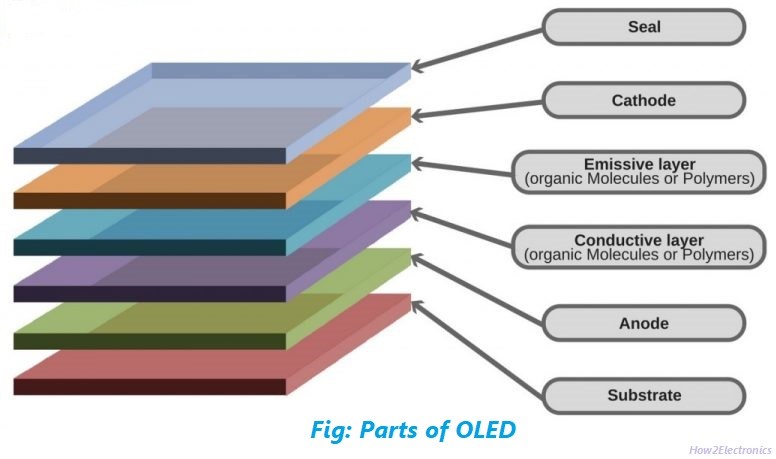
There are six layers on a typical OLED. Two are the outermost layer namely Seal and Substrate. Seal is the top layer and the Substrate is the bottom layer. The next layers are Anode and Cathode. Anode represents the positive terminal and Cathode represents the negative terminal. Between these layers, two layers namely the emissive layer and the conductive layer are sandwiched. Organic molecules or polymers are present in these layers
Modern OLED devices use many more layers to make them more efficient and durable with the same basic functionality.
How Does an OLED Display Work?
When the power of OLED is switched on, the negative terminal i.e. cathode starts receiving electrons from the source and the positive terminal i.e. anode starts losing them. As a result, the emissive layer which is adjacent to the cathode becomes more negatively charged due to an increase in electrons. Similarly, the conductive layer becomes more positively charged due to an increase in holes.

As we know, positively charged particles i.e. holes are more mobile than negatively charged particles i.e. electrons, holes cross to the emissive layer. There is bumping of holes into electrons every time so that bursts of energy are released in the form of photons (fundamental particles of light). Due to which light is emitted. The emission of light continues until the power is ON. The screen does dark after power is OFF as the transfer of charged particles stops instantly. The produced light passes through a color refiner which produces a picture on the screen.
OLED vs. LED

The operational principle of OLED and LED is almost the same which uses colored pixels to show images on the screen however various parameters differentiate them. OLED is the advancement of LED where OLED is composed of organic semiconductor material.
The crucial difference between OLED and LED is the requirement of a backlight to initiate the operation. OLED operates on the principle of self-illuminating which does not require a backlight whereas LED does not work on the principle of self-illumination which require a backlight in order to initiate the operation.
The key differences between OLED and LED are given below.
- OLED does not require a backlight to initiate illumination as it uses organic material that acts as a natural source of light. Whereas LED requires a backlight for its illumination as it is basically a light-emitting diode.
- OLED consumes less power for its operation as compared to LED because of the self-illumination property of OLED which does not require a backlight for operation initiation. So that OLED is much more power efficient than LED.
- OLED displays provide better viewing angles (i.e.84 degrees) as compared to LED (i.e.54 degrees). So that LED provides better picture quality than OLED when viewed from the center and there is deterioration in picture quality when we move either side of the center.
- OLED display provides less brightness as compared to LED.
- OLED permits a thinner screen as compared to LED.
- OLED displays have smaller screen sizes (i.e.90 inches) in comparison to LED (i.e.100 inches).
- OLED provides a faster response time than LED as diodes inside the OLED system respond at a faster rate than a diode in LED.
- OLED does not employ a p-n structure whereas LED uses a p-n structure for dopping.
OLED vs. LCD

LCD (Liquid Crystal Display) is a fairly old technology that has seen a recent burst in advancement. OLED and LCD are different in the sense of how the images are produced. LCD uses liquid crystals which produce an image when light is passed through the display and OLED produces an image by applying electric current to organic materials inside the display.
The main difference between OLED and LCD is the presence of backlight during pixel display. There is no backlight and each pixel gets its own illumination on OLED. whereas pixels are illuminated by backlight on LCD.
The key differences between OLED and LCD are given below.
- OLED does not require a backlight whereas LCD requires a backlight.
- OLEDs consume less power than LCDs.
- OLED has better contrast as compared to LCD.
- The OLED display is much thinner than the LCD display and OLED has a wider viewing angle than LCD.
- LCD is able to produce a brighter image than OLED as the presence of powerful backlight in LCD.
- OLED displays have a significantly lower lifetime than LCD displays.
- There are more applications for OLEDs than LCDs due to the printing technology of OLED
Uses of OLED Display
OLEDs are mainly used in digital devices where operating applications demand high reliability and readability. The current OLED technology provides remarkable color fidelity, operational stability, and high efficiency with low power consumption and a high-quality display.
OLED technology is mainly used in the following applications.
- Televisions and monitors
- Smartphones and tablets
- Digital cameras
- Wearable devices like Smart Watches, Wristbands, and other Accessories
- Portable device displays
- Keyboards
- Light panels
Advantages of OLED
OLED technology offers many advantages over conventional LED and LCD display technology.
The followings are the main advantages of OLED technology.
- Better picture quality
- Ultra-thin, light, and flexible
- Low power consumption
- Large field of view
- Efficient and Eco friendly
- Lower cost in the future
Disadvantages of OLED
Besides the above-cited advantages of OLED technology, there are some disadvantages of OLED technology as compared to LED and LCD technology.
The followings are some disadvantages of OLED technology.
- Shorter Lifetime.
- Susceptible to water and hence can be easily damaged by water.
- Panel production is extremely difficult and expensive.
- Worse screen quality when subjected to direct sunlight.
- Consume more power when displaying images with a white background such as a website or a document.
- Blue light output is relatively small as blue light-emitting OLED material degrades faster than other color materials.
- Limited market availability.