Overview: IoT Applications for Enhanced Living & Working Environments
The Internet of Things (IoT) has brought in a new era of seamless integration of the physical and digital realms to improve both living and working environments. Smart houses have become a trademark of modern living in residential areas, allowing automatic control over lighting, climate, and security systems for unprecedented convenience and energy savings.
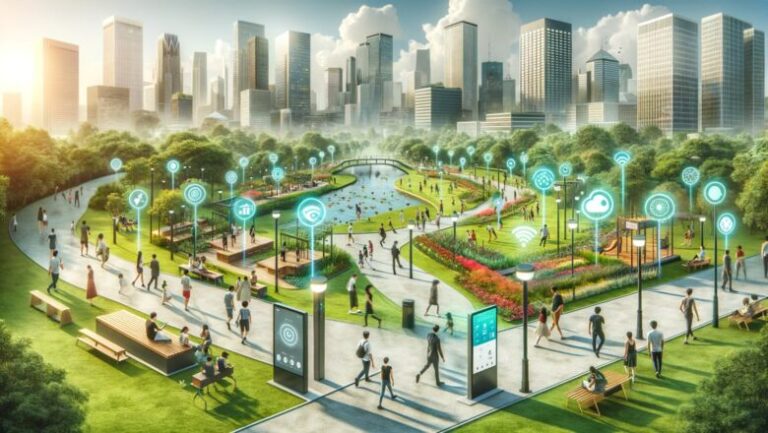
The Internet of Things has also led to the rise of smart cities where the technologies assist urban planning by optimizing traffic flow, waste management, and environmental conditions, resulting in more sustainable and habitable living and working environments. Applications of IoT are revolutionizing the workplace, as evidenced by smart workplaces outfitted with automated technologies that react to occupants’ demands, optimizing energy use and promoting a comfortable and productive environment.
Effects of IoT on Modern Living and Working Spaces
IoT applications in smart cities have had a dramatic impact on modern living and working settings, affecting how we interact with our surroundings and go about our daily lives. Effects of IoT on both living and working environments:

Living Areas:
- Home Automation: IoT allows for the automation of many home operations such as heating, ventilation, lighting, air conditioning, and security systems. This improves both ease and energy efficiency.
- Energy Conservation: IoT sensors and gadgets can monitor energy consumption in real-time, allowing residents to make more informed decisions to minimize consumption and lower utility costs.
Working Environments:
- Energy Management: In the same way that IoT helps to increase energy efficiency in households, it contributes to energy efficiency in office buildings by controlling lights, HVAC systems, and other utilities based on real-time data.
- Collaboration and interconnection: By connecting gadgets such as computers, cellphones, and conference room equipment, IoT enables seamless communication and collaboration. This increases workplace productivity and efficiency. While the IoT environment provides various benefits to modern living and working environments, there are factors that must be considered for the system to reach its full potential. These factors are:
- Security: The greater the number of linked devices, the greater the potential for cybersecurity risks. To protect sensitive data and prevent unwanted access, it is critical to install strong security measures.
- Privacy: Concerns regarding individual privacy and data protection grow as more data is collected from both living and working environments. Clear rules and ethical considerations are required.
Identifying Devices, Connectivity, & Smart Data Management as IoT Fundamentals
1. Devices:
These include:
- Sensors and Actuators: IoT devices frequently incorporate sensors that collect data from their surroundings and actuators that conduct actions depending on that data. Humidity, temperature, light, mobility, and other characteristics can all be measured by sensors.
- Embedded Systems: Many IoT devices are embedded systems, which combine hardware and software to fulfill certain duties. This might range from simple microcontrollers to large systems with advanced processing capabilities.
- Connectivity: In order to transmit and receive data, IoT devices require some type of connection capabilities. This can be accomplished via wired (Ethernet connections, USB) or wireless (Wi-Fi, Bluetooth connectivity, Zigbee, and cellular) connections.
2. Connectivity:
Since IoT devices are frequently in communication with each other, guaranteeing seamless connectivity is critical.

- Wireless Communication Protocols: For flexibility and ease of deployment, IoT devices frequently rely on wireless communication protocols. Wi-Fi and Bluetooth are popular for short-range communication, whilst cellular networks provide for long-range contact.
- Mesh Networking: Mesh networking is used in some IoT applications, where devices connect with one another to build a network that can extend range and enhance reliability.
3. IoT Smart Data Management:
Smart data management measures in IoT include:
- Data Gathering: IoT devices generate massive volumes of data. Smart data management entails efficiently collecting important data and reducing superfluous data transmission.
- Data Processing at the Edge: Processing data at the device’s edge lowers the need to send vast amounts of raw data to a central server. This is particularly relevant for real-time applications, as it can improve privacy by limiting data exposure.

- Cloud Computing: While edge computing is important, cloud platforms are essential for storing, analyzing, and drawing insights from aggregated IoT data. Scalability and centralized management are provided by cloud services for large-scale IoT implementations.
- Security and privacy: In IoT software development there is a need to safeguard data and devices thus strong security measures must be implemented. Encryption, secure authentication, and regular software updates are all part of this. Concerns about privacy should also be addressed by careful data handling techniques.
IoT Applications in Home Automation, Security, & Energy Efficiency
IoT applications have had a tremendous impact on many facets of our daily lives such as home automation, security, and energy efficiency. Here are a few examples of major IoT applications in these domains:
1. Home Automation:
- Smart Lighting in the Home: Users can adjust the brightness, color, and scheduling of lights remotely using smartphone apps with IoT-enabled light bulbs and fixtures. Smart switches and motion sensors also automate lights based on occupancy.

- Smart Home Appliances: Refrigerators, ovens, and other IoT-enabled appliances can be monitored and operated remotely.
2. Security:
- Biometric Security: For access control, IoT-enabled fingerprint scanners, facial recognition, and voice recognition are used.
- Smart Cameras: Motion detection and real-time streaming are features of IoT cameras.
3. Energy Efficiency:
- Smart Lighting: Automated lighting and appliance control to reduce energy consumption.
- Smart Thermostats and HVAC Systems: Heating and cooling are optimized based on occupancy and external weather conditions.
IoT Solutions for Productivity, Collaboration, & Employee Well-being in Connected Workplaces
Internet of Things solutions play a critical role in boosting productivity, enabling collaboration, and supporting employee well-being in linked workplaces. IoT devices are used in smart workplace environments to optimize daily operations and establish efficient workflows. Task management systems, for example, provide real-time insights into employee actions, assisting firms in optimizing work processes.
IoT-powered communication technologies are filled in collaborative spaces, enabling smooth interactions among employees regardless of their physical location. IoT encourages teamwork and innovation in a variety of ways, from smart meeting rooms with automatic scheduling and environmental controls to collaborative platforms that interface with wearable gadgets. Furthermore, IoT systems that monitor working conditions, adjust lighting and temperature based on preferences and provide ergonomic insights prioritize employee well-being.
Exploring Innovations and Upcoming Trends in IoT for Enhanced Environments
Exploring advancements and emerging trends in the IoT highlights a revolutionary journey for better living and working environments. IoT integration is poised to reshape how we interact with and experience our surroundings.

The emergence of smart houses in living environments is distinguished by breakthroughs such as ambient intelligence, in which IoT devices smoothly adapt to occupants’ demands, producing personalized and efficient living experiences. The options for improving daily living are expanding, from smart thermostats that optimize energy use to health-monitoring devices that contribute to well-being.
Similarly, IoT integration is altering traditional office environments in workspaces. The deployment of IoT sensors for space optimization, intelligent lighting systems that adjust to human circadian rhythms, and collaborative platforms that improve communication and productivity is driving the emergence of smart offices. The workplace of the future is becoming more sensitive to its occupants’ needs and preferences, fostering a dynamic, productive workplace.
Conclusion
The Internet of Things (IoT) has the capacity to greatly improve both living and working environments by seamlessly and intelligently connecting gadgets, systems, and people. By integrating all the aforementioned IoT-services, both living and working environments can become more efficient, sustainable, and conducive to individual well-being.