Overview
In this project, we build a DIY Spiderbot Hexapod Robot using ESP32CAM and SSC-32U servo controller. The robot can traverse multiple terrains and stream video using its camera. Notable for its cost-effectiveness and lightweight design, the robot integrates 18 micro servos within a sturdy frame. The assembly process is simplified through the use of plastic hole-and-pin connectors, eliminating the need for screws except for those needed for the servos. This project was sent in by the creator Atlin Anderson.
A standout feature of this hexapod is its FPV (First-Person View) camera, offering adjustable resolution to enhance the user experience. Control is facilitated through a custom Android application, connecting to the robot via a WiFi access point. This feature underscores the project’s emphasis on accessibility and user-friendly operation. The hexapod’s semi-modular electronic mount further contributes to its adaptability, supporting potential upgrades or modifications.
This project distinguishes itself through minimal electronics design, prioritizing ease of assembly and maintenance. Additionally, the customizable nature of the Android control app allows for personalization, tailoring the control interface to suit individual preferences.
Bill of Materials
Following are the list of components required to build DIY Spiderbot Hexapod Robot based on ESP32-CAM Module.
| S.N. | Components | Quantity | Purchase Link |
|---|---|---|---|
| 1 | ESP32 Cam Module | 1 | |
| 2 | FTDI Module | 1 | |
| 3 | SSC-32U Servo Controller | 1 | |
| 4 | Goteck Servo | 22 | |
| 5 | Switch SPST | 1 | |
| 6 | Bread Board Jumpers | 1 | |
| 7 | 7.4V 2000mah Li Battery | 2 | |
| 8 | Li Battery Charger | 2 | |
| 9 | Deans male connector | 6 | |
| 10 | 5V 9A setpdown voltage regulator | 1 | |
| 11 | 2000uF Capaictor | 8 | |
| 12 | Servo cable extenders | 1 | |
| 13 | 2W LED COB | 4 | |
| 14 | 110 ohm resistor | 1 | |
| 15 | BC547 NPN BJT transistor | 1 | |
| 16 | JST connector (for LED) | 20 | |
| 17 | PLA filament | - | |
| 18 | TPU filament | - |
What is a Hexapod Robot?
A hexapod robot is a six-legged mechanical device that mimics the movement of insects, offering stability and flexibility in various terrains.
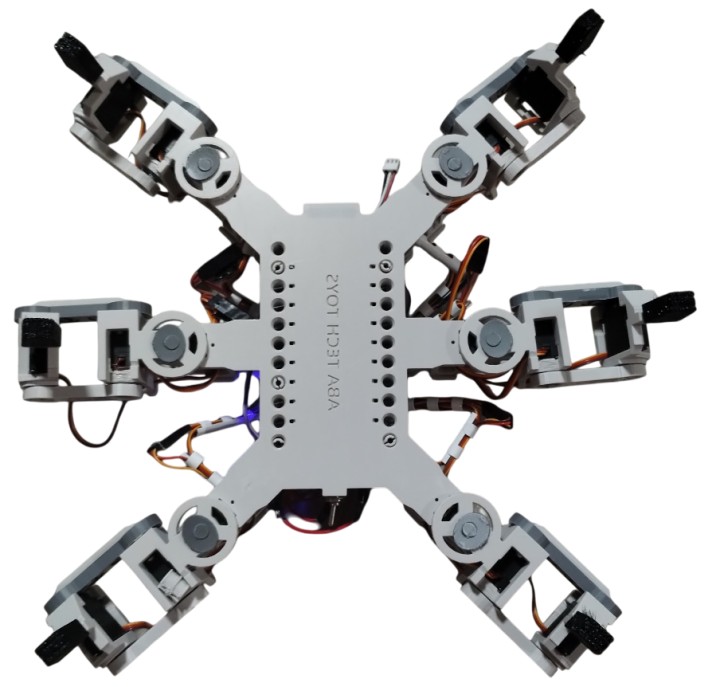
It can perform complex maneuvers such as turning and climbing, thanks to the independent control of each leg. Hexapods are utilized in diverse fields, including research, education, and exploration, benefiting from their ability to navigate difficult environments more effectively than wheeled robots. Their design ranges from simple to highly complex systems, incorporating advanced features like obstacle avoidance, inverse kinematics, and autonomous navigation.
Hardware & Circuit
The circuit diagram depicts the electrical connections for a Hexapod (SpiderBot) Robot with an ESP32-CAM and a servo controller.
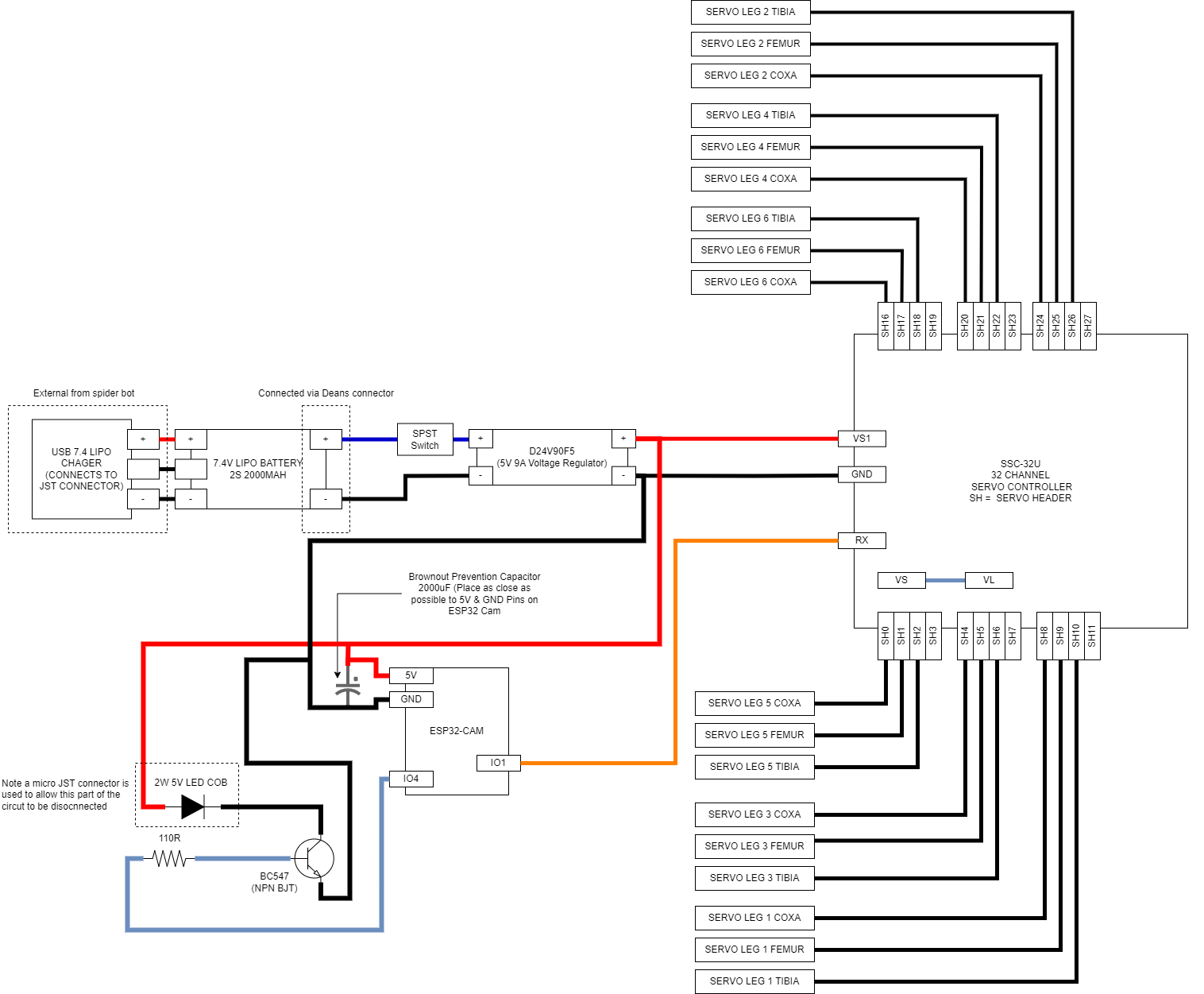
- Power Supply:
- A 7.4V LiPo battery is used to power the circuit, connected through a JST connector.
- A USB 7.4 LiPo removable charger connects to the battery for recharging.
- A voltage regulator (D24V90F5) steps down the voltage to 5V, suitable for powering the ESP32-CAM and servos.
- An SPST (Single Pole Single Throw) switch is used to control the power to the circuit.
- ESP32-CAM:
- This is the microcontroller and camera module that can be used for streaming video and controlling the robot.
- It is powered by the 5V output from the voltage regulator.
- A brownout prevention capacitor is placed close to the ESP32-CAM to stabilize the power supply and prevent the ESP32 from resetting during voltage dips.
- The Ground (GND) from the voltage regulator is connected to the ESP32-CAM’s GND.
- SSC-32U Servo Controller:
- This is a 32-channel servo controller used for controlling multiple servos of the hexapod.
- It is connected to the ESP32-CAM via the RX (Receive) pin for control signals.
- The VS1 input on the servo controller receives power from the voltage regulator.
- VS is connected to VL
- Servos:
- Multiple servos are connected to the servo controller. Each servo connection is labeled (e.g., SERVO LEG 6 COXA) indicating which part of the hexapod it controls.
- LED and Transistor:
- A 2W 5V LED COB (Chip On Board) serves as a light source for the camera to see in dark conditions.
- A 110R resistor limits the current to the LED to prevent it from burning out.
- A B547 (NPN BJT) transistor acts as a switch, controlling the LED’s power state from an IO4 from the ESP32-CAM
- Connectors and Misc:
- A Deans connector is used for a secure power connection.
- A micro JST connector is noted, which allows the lightbar of the circuit to be disconnected when needed.
Software Structure for Operating Hexapod Robot
The diagram illustrates a loop where the user sends commands through the Android app, the ESP32-CAM receives and processes these commands, and then relays instructions to the servo controller to perform the desired actions.
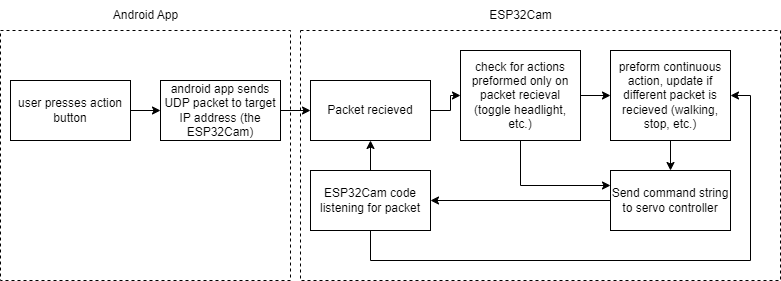
This setup allows for real-time control of the robot’s movements and functions via the Android app.
Android App Side:
- A user interacts with the app by pressing an action button.
- Upon this interaction, the app sends a UDP (User Datagram Protocol) packet to the target IP address, which is the address of the ESP32-CAM module.
ESP32-CAM Side:
- The ESP32-CAM acts as a wifi access point and is continuously running code that listens for incoming UDP packets.
- Once a packet is received, the ESP32-CAM checks for specific actions. These actions could be one-time commands like toggling a headlight or continuous commands like moving.
- If the action requires a continuous operation (e.g., walking, stopping), the ESP32-CAM updates the operation if a different packet is received with a new command.
- After processing the command, the ESP32-CAM sends a corresponding command string to the servo controller, which then translates this into the movements of the robot’s servos.
Source Code/Program
Let us take a look at the code for DIY Spiderbot Hexapod Robot made using ESP32-CAM Module. The code written by Atlin Anderson can be found on the GitHub Repository.
The code is for controlling a six-legged (hexapod) robot equipped with an ESP32-CAM, which functions as both the controller and video streamer. Here’s a breakdown of the main functionalities of the code:
- Initialization and Configuration: The script initializes serial communication, sets up the ESP32-CAM with specific configurations, and establishes a WiFi access point named “ESP32 Spiderbot”. It also configures a web server to handle requests for streaming video in different resolutions and formats.
- Servo Control: It defines variables and functions for controlling the servos that move the robot’s legs. Each leg has three servos (coxa, femur, tibia) and the code includes functions to move these servos to specific angles to achieve walking, rotating, strafing, and other movements.
- UDP Communication: The robot listens for UDP packets on a specific port which controls the robot’s actions like walking forward, backward, rotating, etc., based on commands received over the network.
- Web Server Functions: The server provides endpoints to access live video feeds from the ESP32-CAM in different formats and resolutions (BMP, low-resolution JPEG, high-resolution JPEG, and MJPEG stream).
- Multi-threading: A task is created to handle web server clients separately, ensuring that video streaming operations do not block the main control loop of the robot.
This code effectively makes the spiderbot a remotely controlled robot with live video feedback, showcasing how it can be controlled and monitored via a network.
|
1 2 3 4 5 6 7 8 9 10 11 12 13 14 15 16 17 18 19 20 21 22 23 24 25 26 27 28 29 30 31 32 33 34 35 36 37 38 39 40 41 42 43 44 45 46 47 48 49 50 51 52 53 54 55 56 57 58 59 60 61 62 63 64 65 66 67 68 69 70 71 72 73 74 75 76 77 78 79 80 81 82 83 84 85 86 87 88 89 90 91 92 93 94 95 96 97 98 99 100 101 102 103 104 105 106 107 108 109 110 111 112 113 114 115 116 117 118 119 120 121 122 123 124 125 126 127 128 129 130 131 132 133 134 135 136 137 138 139 140 141 142 143 144 145 146 147 148 149 150 151 152 153 154 155 156 157 158 159 160 161 162 163 164 165 166 167 168 169 170 171 172 173 174 175 176 177 178 179 180 181 182 183 184 185 186 187 188 189 190 191 192 193 194 195 196 197 198 199 200 201 202 203 204 205 206 207 208 209 210 211 212 213 214 215 216 217 218 219 220 221 222 223 224 225 226 227 228 229 230 231 232 233 234 235 236 237 238 239 240 241 242 243 244 245 246 247 248 249 250 251 252 253 254 255 256 257 258 259 260 261 262 263 264 265 266 267 268 269 270 271 272 273 274 275 276 277 278 279 280 281 282 283 284 285 286 287 288 289 290 291 292 293 294 295 296 297 298 299 300 301 302 303 304 305 306 307 308 309 310 311 312 313 314 315 316 317 318 319 320 321 322 323 324 325 326 327 328 329 330 331 332 333 334 335 336 337 338 339 340 341 342 343 344 345 346 347 348 349 350 351 352 353 354 355 356 357 358 359 360 361 362 363 364 365 366 367 368 369 370 371 372 373 374 375 376 377 378 379 380 381 382 383 384 385 386 387 388 389 390 391 392 393 394 395 396 397 398 399 400 401 402 403 404 405 406 407 408 409 410 411 412 413 414 415 416 417 418 419 420 421 422 423 424 425 426 427 428 429 430 431 432 433 434 435 436 437 438 439 440 441 442 443 444 445 446 447 448 449 450 451 452 453 454 455 456 457 458 459 460 461 462 463 464 465 466 467 468 469 470 471 472 473 474 475 476 477 478 479 480 481 482 483 484 485 486 487 488 489 490 491 492 493 494 495 496 497 498 499 500 501 502 503 504 505 506 507 508 509 510 511 512 513 514 515 516 517 518 519 520 521 522 523 524 525 526 527 528 529 530 531 532 533 534 535 536 537 538 539 540 541 542 543 544 545 546 547 548 549 550 551 552 553 554 555 556 557 558 559 560 561 562 563 564 565 566 567 568 569 570 571 572 573 574 575 576 577 578 579 580 581 582 583 584 585 586 587 588 589 590 591 592 593 594 595 596 597 598 599 600 601 602 603 604 605 606 607 608 609 610 611 612 613 614 615 616 617 618 619 620 621 622 623 624 625 626 627 628 629 630 631 632 633 634 635 636 637 638 639 640 641 642 643 644 645 646 647 648 649 650 651 652 653 654 655 656 657 658 659 660 661 662 663 664 665 666 667 668 669 670 671 672 673 674 675 676 677 678 679 680 681 682 683 684 685 686 687 688 689 690 691 692 693 694 695 696 697 698 699 700 701 702 703 704 705 706 707 708 709 710 711 712 713 714 715 716 717 718 719 720 721 722 723 724 725 726 727 728 729 730 731 732 733 734 735 736 737 738 739 740 741 742 743 744 745 746 747 748 749 750 751 752 753 754 755 756 757 758 759 760 761 762 763 764 765 766 767 768 769 770 771 772 773 774 775 776 777 778 779 780 781 782 783 784 785 786 787 788 789 790 791 792 793 794 795 796 797 798 799 800 801 802 803 804 805 806 807 808 809 810 811 812 813 814 815 816 817 818 819 820 821 822 823 824 825 826 827 828 829 830 831 832 833 834 835 836 837 838 839 840 841 842 843 844 845 846 847 848 849 850 851 852 853 854 855 856 857 858 859 860 861 862 863 864 865 866 867 868 869 870 871 872 873 874 875 876 877 878 879 880 881 882 883 884 885 886 887 888 889 890 891 892 893 894 895 896 897 898 899 900 901 902 903 904 905 906 907 908 909 910 911 912 913 914 915 916 917 918 919 920 921 922 923 924 925 926 927 928 929 930 931 932 933 934 935 936 937 938 939 940 941 942 943 944 945 946 947 948 949 950 951 952 953 954 955 956 957 958 959 960 961 962 963 964 965 966 967 968 969 970 971 972 973 974 975 976 977 978 979 980 981 982 983 984 985 986 987 988 989 990 991 992 993 994 995 996 997 998 999 1000 1001 1002 1003 1004 1005 1006 1007 1008 1009 1010 1011 1012 1013 1014 1015 1016 1017 1018 1019 1020 1021 1022 1023 1024 1025 1026 1027 1028 1029 1030 1031 1032 1033 1034 1035 1036 1037 1038 1039 1040 1041 1042 1043 1044 1045 1046 1047 1048 1049 1050 1051 1052 1053 1054 1055 1056 1057 1058 1059 1060 1061 1062 1063 1064 1065 1066 1067 1068 1069 1070 1071 1072 1073 1074 1075 1076 1077 1078 1079 1080 1081 1082 1083 1084 1085 1086 1087 1088 1089 1090 1091 1092 1093 1094 1095 1096 1097 1098 1099 1100 1101 1102 1103 1104 1105 1106 1107 1108 1109 1110 1111 1112 1113 1114 1115 1116 1117 1118 1119 1120 1121 1122 1123 1124 1125 1126 1127 1128 1129 1130 1131 1132 1133 1134 1135 1136 1137 1138 1139 1140 1141 1142 1143 1144 1145 1146 1147 1148 1149 1150 1151 1152 1153 1154 1155 1156 1157 1158 1159 1160 1161 1162 1163 1164 1165 1166 1167 1168 1169 1170 1171 1172 1173 1174 1175 1176 1177 1178 1179 1180 1181 1182 1183 1184 1185 1186 1187 1188 1189 1190 1191 1192 1193 1194 1195 1196 1197 1198 1199 1200 1201 1202 1203 1204 1205 1206 1207 1208 1209 1210 1211 1212 1213 1214 1215 1216 1217 1218 1219 1220 1221 1222 |
//created by ATLIN ANDERSON //BOARD: AI THINKER ESP32-CAM //ESP32 CAM board used #include <WebServer.h> #include <WiFi.h> #include <esp32cam.h> #include <WiFiUdp.h> ///////////////////////////////////////////////////////////// //SPIDERBOT Global Variables///////////////////////////////////////////////////////////// ///////////////////////////////////////////////////////////// // //spider leg assignment diagram // // // // Front // // // //leg 2 leg 1 // // \ / // // leg4- 0 -leg 3 // // / \ // // leg 6 leg 5 // // //group1: 1, 4, 5 // //group2: 2, 3, 6 int max_servo_angle = 85; //leg1 servo binding int servo_coxa_1 = 8; int servo_femur_1 = 9; int servo_tibia_1 = 10; //leg2 servo binding int servo_coxa_2 = 24; int servo_femur_2 = 25; int servo_tibia_2 = 26; //leg3 servo binding int servo_coxa_3 = 4; int servo_femur_3 = 5; int servo_tibia_3 = 6; //leg4 servo binding int servo_coxa_4 = 20; int servo_femur_4 = 21; int servo_tibia_4 = 22; //leg5 servo binding int servo_coxa_5 = 0; int servo_femur_5 = 1; int servo_tibia_5 = 2; //leg6 servo binding int servo_coxa_6 = 16; int servo_femur_6 = 17; int servo_tibia_6 = 18; //spider control variables //default speed of 400ms int servo_speed = 400; int servo_speed_old = 400; //spider control variables //height from 0-9 int spider_height = 5; int spider_height_old = 5; //default standing angles int default_standing_coxa_angle = 0; int default_standing_femur_angle = 0; int default_standing_tibia_angle = 90; //used for timing of movement command unsigned long milli_time_reference = 0; //stores all commands to be sent to servo controller String servo_serial_command_buffer = ""; String servo_serial_command_buffer_old = ""; //adds buffer time between spiderbot action groups int added_time_to_movement_cycle_min = 200; //used for tracking if calibration is enabled bool calibration_tracker = false; ///////////////////////////////////////////////////////////// //Network setup global variables///////////////////////////////////////////////////////////// ///////////////////////////////////////////////////////////// //Wifi Access Point credentials //Set desired SSID name and password const char* WIFI_SSID = "ESP32 Spiderbot"; const char* WIFI_PASS = "0123456789"; // //setting up recieval of UDP Packets WiFiUDP Udp; unsigned int localUdpPort = 4210; // local port to listen on char incomingPacket[2]; // buffer for incoming packets char old_Packet[2]; // buffer for old packets //the first char is the coded action & the section char is either speed or height, if applicable //initate webserver WebServer server(80); //initate a task (to run the camera stream wbeserver on the 2nd core of the ESP32Cam) TaskHandle_t Task1; /////////////////////////////////////////////////////////////// ////ESP32cam Variables///////////////////////////////////////////////////////////// /////////////////////////////////////////////////////////////// static auto loRes = esp32cam::Resolution::find(320, 240); static auto hiRes = esp32cam::Resolution::find(800, 600); void setup() { //enable the GPIO port for LED headlight pinMode(4, OUTPUT); digitalWrite(4, LOW); Serial.begin(9600); //configure ESP32CAM { using namespace esp32cam; Config cfg; cfg.setPins(pins::AiThinker); cfg.setResolution(loRes); cfg.setBufferCount(2); //sewt resultion from 0-100 , 100 being best cfg.setJpeg(50); bool ok = Camera.begin(cfg); //Serial.println(ok ? "CAMERA OK" : "CAMERA FAIL"); } //set up wifi access point WiFi.softAP(WIFI_SSID, WIFI_PASS); // Start the access point //enable the ESP32Cam camera server server.on("/cam.bmp", handleBmp); server.on("/cam-lo.jpg", handleJpgLo); server.on("/cam-hi.jpg", handleJpgHi); server.on("/cam.jpg", handleJpg); server.on("/cam.mjpeg", handleMjpeg); server.begin(); //set up UDP packets Udp.begin(localUdpPort); //create a task that to operate ESP32cam on core 1 xTaskCreatePinnedToCore( Task1code, /* Task function. */ "Task1", /* name of task. */ 10000, /* Stack size of task */ NULL, /* parameter of the task */ 1, /* priority of the task */ &Task1, /* Task handle to keep track of created task */ 0); /* pin task to core 0 */ ///SPIDERBOT SETUP//////////////////////////////////////////////////////////////////////// //set time reference milli_time_reference = millis(); //lay flat on ground leg_group_1_command(0, 0, 0); leg_group_2_command(0, 0, 0); send_serial_command(); delay(2000); //default standing position leg_group_1_command(default_standing_coxa_angle, default_standing_femur_angle, default_standing_tibia_angle); leg_group_2_command(default_standing_coxa_angle, default_standing_femur_angle, default_standing_tibia_angle); send_serial_command(); delay(1000); } void loop() { //check for and read packet if (read_UDP_packet() == true) { //functions only preformed when packet is recieved toggle_LED_headlight(); toogle_calibration_mode(); update_body_height(); update_servo_speed(); } //read & decode the packet & preform action //stop moving and move to default position if (incomingPacket[0] == 'S') { brake(); } //walk forward if (incomingPacket[0] == 'W') { movement_state_transition(old_Packet[0], incomingPacket[0]); walk_forward(milli_time_reference, servo_speed); } //walk backward if (incomingPacket[0] == 'X') { movement_state_transition(old_Packet[0], incomingPacket[0]); walk_backward(milli_time_reference, servo_speed); } //strafe left if (incomingPacket[0] == 'A') { movement_state_transition(old_Packet[0], incomingPacket[0]); strafe_left(milli_time_reference, servo_speed); } //strafe right if (incomingPacket[0] == 'D') { movement_state_transition(old_Packet[0], incomingPacket[0]); strafe_right(milli_time_reference, servo_speed); } //rotate left if (incomingPacket[0] == 'Q') { movement_state_transition(old_Packet[0], incomingPacket[0]); rotate_left(milli_time_reference, servo_speed); } //rotate right if (incomingPacket[0] == 'E') { movement_state_transition(old_Packet[0], incomingPacket[0]); rotate_right(milli_time_reference, servo_speed); } //wave front arm if (incomingPacket[0] == 'H') { movement_state_transition(old_Packet[0], incomingPacket[0]); greeting(milli_time_reference, servo_speed); } //dance if (incomingPacket[0] == 'V') { movement_state_transition(old_Packet[0], incomingPacket[0]); dance(milli_time_reference, servo_speed); } send_serial_command(); old_Packet[0] = incomingPacket[0]; delay(10); } bool read_UDP_packet() { //read UDP Packet int packetSize = Udp.parsePacket(); if (packetSize) { // receive incoming UDP packets int len = Udp.read(incomingPacket, 255); if (len > 0) { incomingPacket[len] = 0; } //Serial.printf("UDP packet contents: %s\n", incomingPacket); //Serial.print(incomingPacket); return true; } return false; } void handleBmp() { if (!esp32cam::Camera.changeResolution(loRes)) { //Serial.println("SET-LO-RES FAIL"); } auto frame = esp32cam::capture(); if (frame == nullptr) { //Serial.println("CAPTURE FAIL"); server.send(503, "", ""); return; } //Serial.printf("CAPTURE OK %dx%d %db\n", frame->getWidth(), frame->getHeight(),static_cast<int>(frame->size())); if (!frame->toBmp()) { //Serial.println("CONVERT FAIL"); server.send(503, "", ""); return; } //Serial.printf("CONVERT OK %dx%d %db\n", frame->getWidth(), frame->getHeight(),static_cast<int>(frame->size())); server.setContentLength(frame->size()); server.send(200, "image/bmp"); WiFiClient client = server.client(); frame->writeTo(client); } void serveJpg() { auto frame = esp32cam::capture(); if (frame == nullptr) { //Serial.println("CAPTURE FAIL"); server.send(503, "", ""); return; } //Serial.printf("CAPTURE OK %dx%d %db\n", frame->getWidth(), frame->getHeight(),static_cast<int>(frame->size())); server.setContentLength(frame->size()); server.send(200, "image/jpeg"); WiFiClient client = server.client(); frame->writeTo(client); } void handleJpgLo() { if (!esp32cam::Camera.changeResolution(loRes)) { //Serial.println("SET-LO-RES FAIL"); } serveJpg(); } void handleJpgHi() { if (!esp32cam::Camera.changeResolution(hiRes)) { //Serial.println("SET-HI-RES FAIL"); } serveJpg(); } void handleJpg() { server.sendHeader("Location", "/cam-hi.jpg"); server.send(302, "", ""); } void handleMjpeg() { if (!esp32cam::Camera.changeResolution(hiRes)) { //Serial.println("SET-HI-RES FAIL"); } //Serial.println("STREAM BEGIN"); WiFiClient client = server.client(); auto startTime = millis(); int res = esp32cam::Camera.streamMjpeg(client); if (res <= 0) { //Serial.printf("STREAM ERROR %d\n", res); return; } auto duration = millis() - startTime; //Serial.printf("STREAM END %dfrm %0.2ffps\n", res, 1000.0 * res / duration); } //Task1code:operates the ESP32 Camera server void Task1code( void * pvParameters ) { for (;;) { server.handleClient(); } } void toggle_LED_headlight() { //toggle LED Headlight if (incomingPacket[0] == 'F') { digitalWrite(4, !digitalRead(4)); incomingPacket[0] = old_Packet[0]; } } void toogle_calibration_mode() { //toggle calibration mode if (incomingPacket[0] == 'C') { if (calibration_tracker == false) { leg_group_1_command (0, 0, 0); leg_group_2_command (0, 0, 0); calibration_tracker = true; } else { leg_group_1_command (-45, 45, 45); leg_group_2_command (-45, 45, 45); calibration_tracker = false; } } } void update_servo_speed() { //update servo speed if (incomingPacket[0] == 'P') { if (incomingPacket[1] == '1') { update_servo_speed_int(1); incomingPacket[0] = old_Packet[0]; incomingPacket[1] = old_Packet[1]; } if (incomingPacket[1] == '2') { update_servo_speed_int(2); incomingPacket[0] = old_Packet[0]; incomingPacket[1] = old_Packet[1]; } if (incomingPacket[1] == '3') { update_servo_speed_int(3); incomingPacket[0] = old_Packet[0]; incomingPacket[1] = old_Packet[1]; } if (incomingPacket[1] == '4') { update_servo_speed_int(4); incomingPacket[0] = old_Packet[0]; incomingPacket[1] = old_Packet[1]; } if (incomingPacket[1] == '5') { update_servo_speed_int(5); incomingPacket[0] = old_Packet[0]; incomingPacket[1] = old_Packet[1]; } if (incomingPacket[1] == '6') { update_servo_speed_int(6); incomingPacket[0] = old_Packet[0]; incomingPacket[1] = old_Packet[1]; } if (incomingPacket[1] == '7') { update_servo_speed_int(7); incomingPacket[0] = old_Packet[0]; incomingPacket[1] = old_Packet[1]; } if (incomingPacket[1] == '8') { update_servo_speed_int(8); incomingPacket[0] = old_Packet[0]; incomingPacket[1] = old_Packet[1]; } if (incomingPacket[1] == '9') { incomingPacket[0] = old_Packet[0]; incomingPacket[1] = old_Packet[1]; } } } void update_body_height() { //update Spider height if (incomingPacket[0] == 'H') { if (incomingPacket[1] == '1') { update_defeault_leg_angles(1); incomingPacket[0] = old_Packet[0]; incomingPacket[1] = old_Packet[1]; } if (incomingPacket[1] == '2') { update_defeault_leg_angles(2); incomingPacket[0] = old_Packet[0]; incomingPacket[1] = old_Packet[1]; } if (incomingPacket[1] == '3') { update_defeault_leg_angles(3); incomingPacket[0] = old_Packet[0]; incomingPacket[1] = old_Packet[1]; } if (incomingPacket[1] == '4') { update_defeault_leg_angles(4); incomingPacket[0] = old_Packet[0]; incomingPacket[1] = old_Packet[1]; } if (incomingPacket[1] == '5') { update_defeault_leg_angles(5); incomingPacket[0] = old_Packet[0]; incomingPacket[1] = old_Packet[1]; } if (incomingPacket[1] == '6') { update_defeault_leg_angles(6); incomingPacket[0] = old_Packet[0]; incomingPacket[1] = old_Packet[1]; } if (incomingPacket[1] == '7') { update_defeault_leg_angles(7); incomingPacket[0] = old_Packet[0]; incomingPacket[1] = old_Packet[1]; } if (incomingPacket[1] == '8') { update_defeault_leg_angles(8); incomingPacket[0] = old_Packet[0]; incomingPacket[1] = old_Packet[1]; } if (incomingPacket[1] == '9') { update_defeault_leg_angles(9); incomingPacket[0] = old_Packet[0]; incomingPacket[1] = old_Packet[1]; } } } void send_serial_command() { //send the final serial command string appended with servo speed if (servo_serial_command_buffer.length() > 0 && servo_serial_command_buffer != servo_serial_command_buffer_old || servo_speed_old != servo_speed || spider_height_old != spider_height) { Serial.println(servo_serial_command_buffer + "T" + String(servo_speed)); } //then reset the string for new command servo_serial_command_buffer_old = servo_serial_command_buffer; servo_serial_command_buffer = ""; } void update_servo_speed_int(int speed_int) { int max_servo_speed = 150; int min_servo_speed = 1000; //max is 850 but tends to cause robot errors speed_int = constrain(speed_int, 1, 9); servo_speed = map(speed_int, 1, 9, min_servo_speed, max_servo_speed); servo_speed_old = servo_speed; } void movement_state_transition(char old_command, char new_command) { int transition_delay = servo_speed + 150; //was 50 if (old_command != new_command) { delay(transition_delay); brake(); servo_serial_command_buffer = ""; } } void update_defeault_leg_angles(int normalized_spider_height) { default_standing_femur_angle = map(normalized_spider_height, 1, 9, 45, -45); default_standing_tibia_angle = 90 + default_standing_femur_angle; spider_height = normalized_spider_height; spider_height_old = normalized_spider_height; } void servo_position(int servo_num, int servo_angle, int servo_speed) { //speed 100-9999 servo_angle = map(servo_angle, -max_servo_angle, max_servo_angle, -90, 90); servo_angle = map(servo_angle, -90, 90, 500, 2500); servo_angle = constrain(servo_angle, 500, 2500); Serial.print("#" + String(servo_num) + "P" + String(servo_angle) + "T" + String(servo_speed)); return; } void multi_servo_position(int servo_num1, int servo_angle1, int servo_num2, int servo_angle2, int servo_num3, int servo_angle3) { //speed 100-9999 servo_angle1 = map(servo_angle1, -max_servo_angle, max_servo_angle, -90, 90); servo_angle1 = map(servo_angle1, -90, 90, 500, 2500); servo_angle1 = constrain(servo_angle1, 500, 2500); servo_angle2 = map(servo_angle2, -max_servo_angle, max_servo_angle, -90, 90); servo_angle2 = map(servo_angle2, -90, 90, 500, 2500); servo_angle2 = constrain(servo_angle2, 500, 2500); servo_angle3 = map(servo_angle3, -max_servo_angle, max_servo_angle, -90, 90); servo_angle3 = map(-servo_angle3, -90, 90, 500, 2500); servo_angle3 = constrain(servo_angle3, 500, 2500); //Serial.print("#" + String(servo_num1) + "P" + String(servo_angle1) + "#" + String(servo_num2) + "P" + String(servo_angle2) + "#" + String(servo_num3) + "P" + String(servo_angle3) + "T" + String(servo_speed) + "\r\n"); servo_serial_command_buffer = servo_serial_command_buffer + "#" + String(servo_num1) + "P" + String(servo_angle1) + "#" + String(servo_num2) + "P" + String(servo_angle2) + "#" + String(servo_num3) + "P" + String(servo_angle3); return; } void servo_test() { for (int i = 0; i <= 23; i++) { servo_position(i, -90, 100); delay(1000); servo_position(i, 90, 100); delay(1000); servo_position(i, 0, 100); delay(1000); } } void specific_leg_relative_command(int leg_ID, int coxa_servo_angle, int femur_servo_angle, int tibia_servo_angle) { //spider leg assignment diagram // Front // //leg 2 leg 1 // \ / // leg4- 0 -leg 3 // / \ // leg 6 leg 5 //group1: 1, 4, 5 //group2: 2, 3, 6 switch (leg_ID) { //command group1 case 1: multi_servo_position(servo_coxa_1, -coxa_servo_angle, servo_femur_1, -femur_servo_angle, servo_tibia_1, tibia_servo_angle); break; case 2: multi_servo_position(servo_coxa_2, coxa_servo_angle, servo_femur_2, femur_servo_angle, servo_tibia_2, -tibia_servo_angle); break; case 3: multi_servo_position(servo_coxa_3, -coxa_servo_angle, servo_femur_3, -femur_servo_angle, servo_tibia_3, tibia_servo_angle); break; //command group 2 case 4: multi_servo_position(servo_coxa_4, coxa_servo_angle, servo_femur_4, femur_servo_angle, servo_tibia_4, -tibia_servo_angle); break; case 5: multi_servo_position(servo_coxa_5, -coxa_servo_angle, servo_femur_5, -femur_servo_angle, servo_tibia_5, tibia_servo_angle); break; case 6: multi_servo_position(servo_coxa_6, coxa_servo_angle, servo_femur_6, femur_servo_angle, servo_tibia_6, -tibia_servo_angle); break; default: break; } } void leg_group_1_command(int coxa_servo_angle, int femur_servo_angle, int tibia_servo_angle) { //legs 1, 4, 5 // //coxa multi_servo_position(servo_coxa_1, -coxa_servo_angle, servo_coxa_4, coxa_servo_angle, servo_coxa_5, coxa_servo_angle); // //femur multi_servo_position(servo_femur_1, -femur_servo_angle, servo_femur_4, femur_servo_angle, servo_femur_5, femur_servo_angle); // // //tibia multi_servo_position(servo_tibia_1, -tibia_servo_angle, servo_tibia_4, tibia_servo_angle, servo_tibia_5, tibia_servo_angle); } void leg_group_2_command(int coxa_servo_angle, int femur_servo_angle, int tibia_servo_angle) { //legs 2, 3, 6 // //coxa multi_servo_position(servo_coxa_2, coxa_servo_angle, servo_coxa_3, -coxa_servo_angle, servo_coxa_6, -coxa_servo_angle); // //femur multi_servo_position(servo_femur_2, femur_servo_angle, servo_femur_3, -femur_servo_angle, servo_femur_6, -femur_servo_angle); // //tibia multi_servo_position(servo_tibia_2, tibia_servo_angle, servo_tibia_3, -tibia_servo_angle, servo_tibia_6, -tibia_servo_angle); } void brake() { //stand still leg_group_1_command(default_standing_coxa_angle, default_standing_femur_angle, default_standing_tibia_angle); leg_group_2_command(default_standing_coxa_angle, default_standing_femur_angle, default_standing_tibia_angle); } void walk_forward(int reference_time_millis, int servo_speed) { //total seperate actions preformed int action_group_count = 4; //add time to movement cycle to allow for movement speed slower than expected (respects a min value) int added_time_to_movement_cycle = servo_speed * 2; if (added_time_to_movement_cycle < added_time_to_movement_cycle_min) { added_time_to_movement_cycle = added_time_to_movement_cycle_min; } //how long it take to repeat the action (ms) int movement_cycle_period = servo_speed * action_group_count + added_time_to_movement_cycle; //how many ms have elapsed during the current movemnt cycle int current_movement_cycle_elapsed = (millis() - reference_time_millis) % movement_cycle_period; //determine which action group to do based on how much time has elapsed in the period of the movement cycle if (current_movement_cycle_elapsed < movement_cycle_period / action_group_count) { //ACTION GROUP 1 leg_group_2_command(42, 85, 85); //leg group 2 forward and up leg_group_1_command(0, default_standing_femur_angle, default_standing_tibia_angle); //leg group 1 back to default pos } else if (current_movement_cycle_elapsed > (movement_cycle_period / action_group_count) * 1 && current_movement_cycle_elapsed < (movement_cycle_period / action_group_count) * 2) { //ACTION GROUP 2 leg_group_2_command(42, default_standing_femur_angle, default_standing_tibia_angle); //leg group 2 down } else if (current_movement_cycle_elapsed > (movement_cycle_period / action_group_count) * 2 && current_movement_cycle_elapsed < (movement_cycle_period / action_group_count) * 3) { //ACTION GROUP 3 leg_group_2_command(0, default_standing_femur_angle, default_standing_tibia_angle); //leg group 2 back to default pos leg_group_1_command(42, 85, 85); // leg group 1 fowrd and up } else if (current_movement_cycle_elapsed > (movement_cycle_period / action_group_count) * 3 && current_movement_cycle_elapsed < (movement_cycle_period / action_group_count) * 4) { //ACTION GROUP 4 leg_group_1_command(42, default_standing_femur_angle, default_standing_tibia_angle); //leg group 1 down } } void walk_backward(int reference_time_millis, int servo_speed) { //total seperate actions preformed int action_group_count = 4; //add time to movement cycle to allow for movement speed slower than expected (respects a min value) int added_time_to_movement_cycle = servo_speed * 2; if (added_time_to_movement_cycle < added_time_to_movement_cycle_min) { added_time_to_movement_cycle = added_time_to_movement_cycle_min; } //how long it take to repeat the action (ms) int movement_cycle_period = servo_speed * action_group_count + added_time_to_movement_cycle; //how many ms have elapsed during the current movemnt cycle int current_movement_cycle_elapsed = (millis() - reference_time_millis) % movement_cycle_period; //determine which action group to do based on how much time has elapsed in the period of the movement cycle if (current_movement_cycle_elapsed < movement_cycle_period / action_group_count) { //ACTION GROUP 1 leg_group_2_command(-42, 85, 85); //leg group 2 forward and up leg_group_1_command(0, default_standing_femur_angle, default_standing_tibia_angle); //leg group 1 back to default pos } else if (current_movement_cycle_elapsed > (movement_cycle_period / action_group_count) * 1 && current_movement_cycle_elapsed < (movement_cycle_period / action_group_count) * 2) { //ACTION GROUP 2 leg_group_2_command(-42, default_standing_femur_angle, default_standing_tibia_angle); //leg group 2 down } else if (current_movement_cycle_elapsed > (movement_cycle_period / action_group_count) * 2 && current_movement_cycle_elapsed < (movement_cycle_period / action_group_count) * 3) { //ACTION GROUP 3 leg_group_2_command(0, default_standing_femur_angle, default_standing_tibia_angle); //leg group 2 back to default pos leg_group_1_command(-42, 85, 85); // leg group 1 fowrd and up } else if (current_movement_cycle_elapsed > (movement_cycle_period / action_group_count) * 3 && current_movement_cycle_elapsed < (movement_cycle_period / action_group_count) * 4) { //ACTION GROUP 4 leg_group_1_command(-42, default_standing_femur_angle, default_standing_tibia_angle); //leg group 1 down } } void rotate_left(int reference_time_millis, int servo_speed) { // int default_standing_coxa_angle = 0; //int default_standing_femur_angle = 5; //int default_standing_tibia_angle = 85; //total seperate actions preformed int action_group_count = 4; //add time to movement cycle to allow for movement speed slower than expected (respects a min value) int added_time_to_movement_cycle = servo_speed * 2; if (added_time_to_movement_cycle < added_time_to_movement_cycle_min) { added_time_to_movement_cycle = added_time_to_movement_cycle_min; } //how long it take to repeat the action (ms) int movement_cycle_period = servo_speed * action_group_count + added_time_to_movement_cycle; //how many ms have elapsed during the current movemnt cycle int current_movement_cycle_elapsed = (millis() - reference_time_millis) % movement_cycle_period; //determine which action group to do based on how much time has elapsed in the period of the movement cycle if (current_movement_cycle_elapsed < movement_cycle_period / action_group_count) { //ACTION GROUP 1 //leg_group_2_command (-45, -45, 85); //leg group 2 forward and up //leg_group_1_command (0, -5, 85); //leg group 1 back to default pos specific_leg_relative_command(1, default_standing_coxa_angle, default_standing_femur_angle, default_standing_tibia_angle); specific_leg_relative_command(2, -40, 45, 5); specific_leg_relative_command(3, 40, 45, 5); specific_leg_relative_command(4, default_standing_coxa_angle, default_standing_femur_angle, default_standing_tibia_angle); specific_leg_relative_command(5, default_standing_coxa_angle, default_standing_femur_angle, default_standing_tibia_angle); specific_leg_relative_command(6, -40, 45, 5); } else if (current_movement_cycle_elapsed > (movement_cycle_period / action_group_count) * 1 && current_movement_cycle_elapsed < (movement_cycle_period / action_group_count) * 2) { //ACTION GROUP 2 specific_leg_relative_command(2, -40, default_standing_femur_angle, default_standing_tibia_angle); specific_leg_relative_command(3, 40, default_standing_femur_angle, default_standing_tibia_angle); specific_leg_relative_command(6, -40, default_standing_femur_angle, default_standing_tibia_angle); } else if (current_movement_cycle_elapsed > (movement_cycle_period / action_group_count) * 2 && current_movement_cycle_elapsed < (movement_cycle_period / action_group_count) * 3) { //ACTION GROUP 3 //leg_group_1_command (-45, -45, 85); // leg group 1 fowrd and up specific_leg_relative_command(1, 40, 45, 5); specific_leg_relative_command(2, default_standing_coxa_angle, default_standing_femur_angle, default_standing_tibia_angle); specific_leg_relative_command(3, default_standing_coxa_angle, default_standing_femur_angle, default_standing_tibia_angle); specific_leg_relative_command(4, -40, 45, 5); specific_leg_relative_command(5, 40, 45, 5); specific_leg_relative_command(6, default_standing_coxa_angle, default_standing_femur_angle, default_standing_tibia_angle); } else if (current_movement_cycle_elapsed > (movement_cycle_period / action_group_count) * 3 && current_movement_cycle_elapsed < (movement_cycle_period / action_group_count) * 4) { //ACTION GROUP 4 //leg_group_1_command (-45, -5, 85); //leg group 1 down specific_leg_relative_command(1, 40, default_standing_femur_angle, default_standing_tibia_angle); specific_leg_relative_command(4, -40, default_standing_femur_angle, default_standing_tibia_angle); specific_leg_relative_command(5, 40, default_standing_femur_angle, default_standing_tibia_angle); } } void rotate_right(int reference_time_millis, int servo_speed) { // int default_standing_coxa_angle = 0; //int default_standing_femur_angle = 5; //int default_standing_tibia_angle = 85; //total seperate actions preformed int action_group_count = 4; //add time to movement cycle to allow for movement speed slower than expected (respects a min value) int added_time_to_movement_cycle = servo_speed * 2; if (added_time_to_movement_cycle < added_time_to_movement_cycle_min) { added_time_to_movement_cycle = added_time_to_movement_cycle_min; } //how long it take to repeat the action (ms) int movement_cycle_period = servo_speed * action_group_count + added_time_to_movement_cycle; //how many ms have elapsed during the current movemnt cycle int current_movement_cycle_elapsed = (millis() - reference_time_millis) % movement_cycle_period; //determine which action group to do based on how much time has elapsed in the period of the movement cycle if (current_movement_cycle_elapsed < movement_cycle_period / action_group_count) { //ACTION GROUP 1 //leg_group_2_command (-45, -45, 85); //leg group 2 forward and up //leg_group_1_command (0, -5, 85); //leg group 1 back to default pos specific_leg_relative_command(1, default_standing_coxa_angle, default_standing_femur_angle, default_standing_tibia_angle); specific_leg_relative_command(2, 40, 45, 5); specific_leg_relative_command(3, -40, 45, 5); specific_leg_relative_command(4, default_standing_coxa_angle, default_standing_femur_angle, default_standing_tibia_angle); specific_leg_relative_command(5, default_standing_coxa_angle, default_standing_femur_angle, default_standing_tibia_angle); specific_leg_relative_command(6, 40, 45, 5); } else if (current_movement_cycle_elapsed > (movement_cycle_period / action_group_count) * 1 && current_movement_cycle_elapsed < (movement_cycle_period / action_group_count) * 2) { //ACTION GROUP 2 //leg_group_2_command (-45, -5, 85); //leg group 2 down specific_leg_relative_command(2, 40, default_standing_femur_angle, default_standing_tibia_angle); specific_leg_relative_command(3, -40, default_standing_femur_angle, default_standing_tibia_angle); specific_leg_relative_command(6, 40, default_standing_femur_angle, default_standing_tibia_angle); } else if (current_movement_cycle_elapsed > (movement_cycle_period / action_group_count) * 2 && current_movement_cycle_elapsed < (movement_cycle_period / action_group_count) * 3) { //ACTION GROUP 3 //leg_group_1_command (-45, -45, 85); // leg group 1 fowrd and up specific_leg_relative_command(1, -40, 45, 5); specific_leg_relative_command(2, default_standing_coxa_angle, default_standing_femur_angle, default_standing_tibia_angle); specific_leg_relative_command(3, default_standing_coxa_angle, default_standing_femur_angle, default_standing_tibia_angle); specific_leg_relative_command(4, 40, 45, 5); specific_leg_relative_command(5, -40, 45, 5); specific_leg_relative_command(6, default_standing_coxa_angle, default_standing_femur_angle, default_standing_tibia_angle); } else if (current_movement_cycle_elapsed > (movement_cycle_period / action_group_count) * 3 && current_movement_cycle_elapsed < (movement_cycle_period / action_group_count) * 4) { //ACTION GROUP 4 //leg_group_1_command (-45, -5, 85); //leg group 1 down specific_leg_relative_command(1, -40, default_standing_femur_angle, default_standing_tibia_angle); specific_leg_relative_command(4, 40, default_standing_femur_angle, default_standing_tibia_angle); specific_leg_relative_command(5, -40, default_standing_femur_angle, default_standing_tibia_angle); } } void strafe_right(int reference_time_millis, int servo_speed) { // int default_standing_coxa_angle = 0; //int default_standing_femur_angle = 5; //int default_standing_tibia_angle = 85; //total seperate actions preformed int action_group_count = 6; //add time to movement cycle to allow for movement speed slower than expected (respects a min value) int added_time_to_movement_cycle = servo_speed * 2; if (added_time_to_movement_cycle < added_time_to_movement_cycle_min) { added_time_to_movement_cycle = added_time_to_movement_cycle_min; } //how long it take to repeat the action (ms) int movement_cycle_period = servo_speed * action_group_count + added_time_to_movement_cycle; //how many ms have elapsed during the current movemnt cycle int current_movement_cycle_elapsed = (millis() - reference_time_millis) % movement_cycle_period; //determine which action group to do based on how much time has elapsed in the period of the movement cycle if (current_movement_cycle_elapsed < movement_cycle_period / action_group_count) { //ACTION GROUP 1 specific_leg_relative_command(1, -45, 45, 70); specific_leg_relative_command(2, -45, -10, 110); specific_leg_relative_command(3, 0, -55, 10); specific_leg_relative_command(4, 0, 45, 90); specific_leg_relative_command(5, 45, 45, 70); specific_leg_relative_command(6, 45, -10, 110); } else if (current_movement_cycle_elapsed > (movement_cycle_period / action_group_count) * 1 && current_movement_cycle_elapsed < (movement_cycle_period / action_group_count) * 2) { //ACTION GROUP 2 specific_leg_relative_command(1, -45, 45, 90); specific_leg_relative_command(2, -45, -10, 20); specific_leg_relative_command(3, 0, -50, 110); specific_leg_relative_command(4, 0, 45, 90); specific_leg_relative_command(5, 45, 45, 90); specific_leg_relative_command(6, 45, -10, 20); } else if (current_movement_cycle_elapsed > (movement_cycle_period / action_group_count) * 2 && current_movement_cycle_elapsed < (movement_cycle_period / action_group_count) * 3) { //ACTION GROUP 3 specific_leg_relative_command(1, -45, -55, 10); specific_leg_relative_command(2, -45, -10, 55); specific_leg_relative_command(3, 0, -10, 130); specific_leg_relative_command(4, 0, -10, 110); specific_leg_relative_command(5, 45, -55, 10); specific_leg_relative_command(6, 45, -10, 55); } else if (current_movement_cycle_elapsed > (movement_cycle_period / action_group_count) * 3 && current_movement_cycle_elapsed < (movement_cycle_period / action_group_count) * 4) { //ACTION GROUP 4 specific_leg_relative_command(1, -45, -55, 10); specific_leg_relative_command(2, -45, 70, 110); specific_leg_relative_command(3, 0, 45, 70); specific_leg_relative_command(4, 0, -10, 90); specific_leg_relative_command(5, 45, -55, 10); specific_leg_relative_command(6, 45, 70, 110); } else if (current_movement_cycle_elapsed > (movement_cycle_period / action_group_count) * 4 && current_movement_cycle_elapsed < (movement_cycle_period / action_group_count) * 5) { //ACTION GROUP 5 specific_leg_relative_command(1, -45, -10, 110); specific_leg_relative_command(2, -45, 70, 110); specific_leg_relative_command(3, 0, 45, 70); specific_leg_relative_command(4, 0, -10, 30); specific_leg_relative_command(5, 45, -10, 110); specific_leg_relative_command(6, 45, 70, 110); } else if (current_movement_cycle_elapsed > (movement_cycle_period / action_group_count) * 5 && current_movement_cycle_elapsed < (movement_cycle_period / action_group_count) * 6) { //ACTION GROUP 6 specific_leg_relative_command(1, -45, -10, 110); specific_leg_relative_command(2, -45, -10, 110); specific_leg_relative_command(3, 0, -55, 10); specific_leg_relative_command(4, 0, -10, 30); specific_leg_relative_command(5, 45, -10, 110); specific_leg_relative_command(6, 45, -10, 110); } } void strafe_left(int reference_time_millis, int servo_speed) { // int default_standing_coxa_angle = 0; //int default_standing_femur_angle = 5; //int default_standing_tibia_angle = 85; //total seperate actions preformed int action_group_count = 6; //add time to movement cycle to allow for movement speed slower than expected (respects a min value) int added_time_to_movement_cycle = servo_speed * 2; if (added_time_to_movement_cycle < added_time_to_movement_cycle_min) { added_time_to_movement_cycle = added_time_to_movement_cycle_min; } //how long it take to repeat the action (ms) int movement_cycle_period = servo_speed * action_group_count + added_time_to_movement_cycle; //how many ms have elapsed during the current movemnt cycle int current_movement_cycle_elapsed = (millis() - reference_time_millis) % movement_cycle_period; //determine which action group to do based on how much time has elapsed in the period of the movement cycle if (current_movement_cycle_elapsed < movement_cycle_period / action_group_count) { //ACTION GROUP 1 specific_leg_relative_command(2, -45, 45, 70); specific_leg_relative_command(1, -45, -10, 110); specific_leg_relative_command(4, 0, -55, 10); specific_leg_relative_command(3, 0, 45, 90); specific_leg_relative_command(6, 45, 45, 70); specific_leg_relative_command(5, 45, -10, 110); } else if (current_movement_cycle_elapsed > (movement_cycle_period / action_group_count) * 1 && current_movement_cycle_elapsed < (movement_cycle_period / action_group_count) * 2) { //ACTION GROUP 2 specific_leg_relative_command(2, -45, 45, 90); specific_leg_relative_command(1, -45, -10, 20); specific_leg_relative_command(4, 0, -50, 110); specific_leg_relative_command(3, 0, 45, 90); specific_leg_relative_command(6, 45, 45, 90); specific_leg_relative_command(5, 45, -10, 20); } else if (current_movement_cycle_elapsed > (movement_cycle_period / action_group_count) * 2 && current_movement_cycle_elapsed < (movement_cycle_period / action_group_count) * 3) { //ACTION GROUP 3 specific_leg_relative_command(2, -45, -55, 10); specific_leg_relative_command(1, -45, -10, 55); specific_leg_relative_command(4, 0, -10, 130); specific_leg_relative_command(3, 0, -10, 110); specific_leg_relative_command(6, 45, -55, 10); specific_leg_relative_command(5, 45, -10, 55); } else if (current_movement_cycle_elapsed > (movement_cycle_period / action_group_count) * 3 && current_movement_cycle_elapsed < (movement_cycle_period / action_group_count) * 4) { //ACTION GROUP 4 specific_leg_relative_command(2, -45, -55, 10); specific_leg_relative_command(1, -45, 70, 110); specific_leg_relative_command(4, 0, 45, 70); specific_leg_relative_command(3, 0, -10, 90); specific_leg_relative_command(6, 45, -55, 10); specific_leg_relative_command(5, 45, 70, 110); } else if (current_movement_cycle_elapsed > (movement_cycle_period / action_group_count) * 4 && current_movement_cycle_elapsed < (movement_cycle_period / action_group_count) * 5) { //ACTION GROUP 5 specific_leg_relative_command(2, -45, -10, 110); specific_leg_relative_command(1, -45, 70, 110); specific_leg_relative_command(4, 0, 45, 70); specific_leg_relative_command(3, 0, -10, 30); specific_leg_relative_command(6, 45, -10, 110); specific_leg_relative_command(5, 45, 70, 110); } else if (current_movement_cycle_elapsed > (movement_cycle_period / action_group_count) * 5 && current_movement_cycle_elapsed < (movement_cycle_period / action_group_count) * 6) { //ACTION GROUP 6 specific_leg_relative_command(2, -45, -10, 110); specific_leg_relative_command(1, -45, -10, 110); specific_leg_relative_command(4, 0, -55, 10); specific_leg_relative_command(3, 0, -10, 30); specific_leg_relative_command(6, 45, -10, 110); specific_leg_relative_command(5, 45, -10, 110); } } void greeting(int reference_time_millis, int servo_speed) { // int default_standing_coxa_angle = 0; //int default_standing_femur_angle = 5; //int default_standing_tibia_angle = 85; //total seperate actions preformed int action_group_count = 2; //add time to movement cycle to allow for movement speed slower than expected (respects a min value) int added_time_to_movement_cycle = servo_speed * 2; if (added_time_to_movement_cycle < added_time_to_movement_cycle_min) { added_time_to_movement_cycle = added_time_to_movement_cycle_min; } //how long it take to repeat the action (ms) int movement_cycle_period = servo_speed * action_group_count + added_time_to_movement_cycle; //how many ms have elapsed during the current movemnt cycle int current_movement_cycle_elapsed = (millis() - reference_time_millis) % movement_cycle_period; //determine which action group to do based on how much time has elapsed in the period of the movement cycle if (current_movement_cycle_elapsed < movement_cycle_period / action_group_count) { //ACTION GROUP 1 specific_leg_relative_command(1, -45, default_standing_femur_angle, -90); specific_leg_relative_command(2, default_standing_coxa_angle, default_standing_femur_angle, default_standing_tibia_angle); specific_leg_relative_command(3, default_standing_coxa_angle, default_standing_femur_angle, default_standing_tibia_angle); specific_leg_relative_command(4, default_standing_coxa_angle, default_standing_femur_angle, default_standing_tibia_angle); specific_leg_relative_command(5, default_standing_coxa_angle, default_standing_femur_angle, default_standing_tibia_angle); specific_leg_relative_command(6, default_standing_coxa_angle, default_standing_femur_angle, default_standing_tibia_angle); } else if (current_movement_cycle_elapsed > (movement_cycle_period / action_group_count) * 1 && current_movement_cycle_elapsed < (movement_cycle_period / action_group_count) * 2) { //ACTION GROUP 2 specific_leg_relative_command(1, -45, default_standing_femur_angle, -20); } } void dance(int reference_time_millis, int servo_speed) { //total seperate actions preformed int action_group_count = 2; //add time to movement cycle to allow for movement speed slower than expected (respects a min value) int added_time_to_movement_cycle = servo_speed * 2; if (added_time_to_movement_cycle < added_time_to_movement_cycle_min) { added_time_to_movement_cycle = added_time_to_movement_cycle_min; } //how long it take to repeat the action (ms) int movement_cycle_period = servo_speed * action_group_count + added_time_to_movement_cycle; //how many ms have elapsed during the current movemnt cycle int current_movement_cycle_elapsed = (millis() - reference_time_millis) % movement_cycle_period; //determine which action group to do based on how much time has elapsed in the period of the movement cycle if (current_movement_cycle_elapsed < movement_cycle_period / action_group_count) { //ACTION GROUP 1 specific_leg_relative_command(1, -45, 0, 130); specific_leg_relative_command(2, -45, 0, 40); specific_leg_relative_command(3, 0, 45, -45); specific_leg_relative_command(4, 0, 45, -45); specific_leg_relative_command(5, 45, 0, 130); specific_leg_relative_command(6, 45, 0, 40); } else if (current_movement_cycle_elapsed > (movement_cycle_period / action_group_count) * 1 && current_movement_cycle_elapsed < (movement_cycle_period / action_group_count) * 2) { //ACTION GROUP 2 // specific_leg_relative_command(1, -45, 0, 40); specific_leg_relative_command(2, -45, 0, 130); specific_leg_relative_command(3, 0, 0, -90); specific_leg_relative_command(4, 0, 0, -90); specific_leg_relative_command(5, 45, 0, 40); specific_leg_relative_command(6, 45, 0, 130); } } |
3D Model & Casing
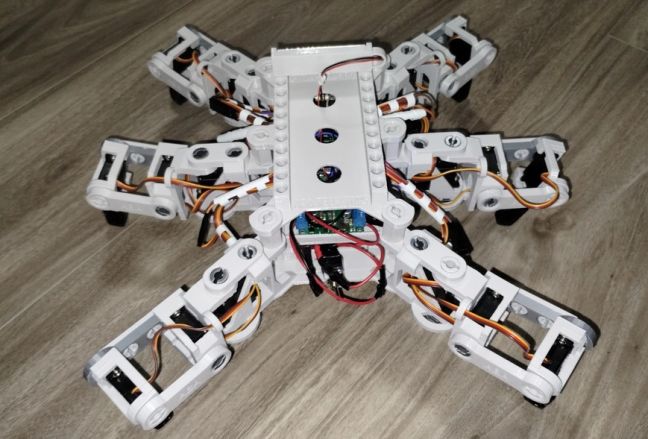
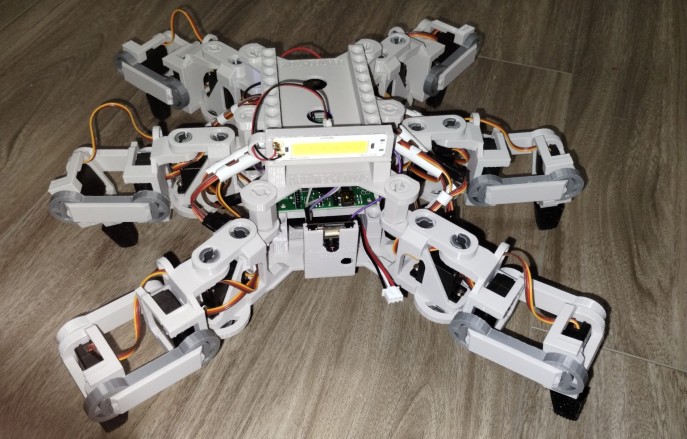
This 3D model represents an open-source, 3D-printed, low-cost hexapod designed as an expandable and durable robotics platform.
It is crafted to be lightweight and compact, making it suitable for various applications.
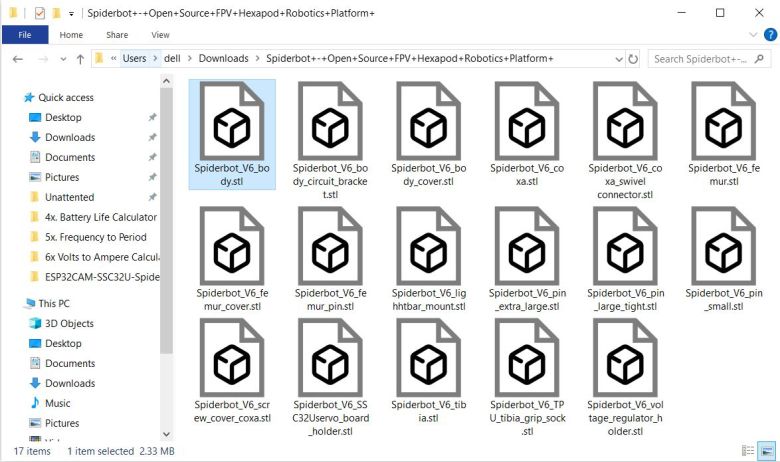
The hexapod integrates a First-Person View (FPV) camera that provides real-time video feedback, enhancing its usability in remote or visually restrictive environments.
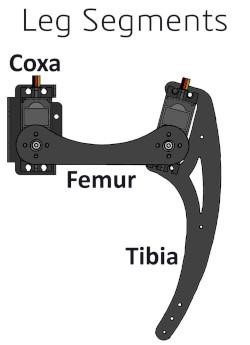
The design features a semi-modular electronic mounting system, allowing for straightforward upgrades and maintenance. Assembly of the robot is efficient, requiring minimal screws, with most only necessary for securing the servo heads. This project emphasizes a minimal electronics approach, aiming to keep the construction and maintenance process as simple as possible while ensuring reliability and functionality.
Android App for Robot Control
For controlling the DIY Spiderbot Hexapod Robot, we will use an Android App. The App has been designed using MIT App Inventor.
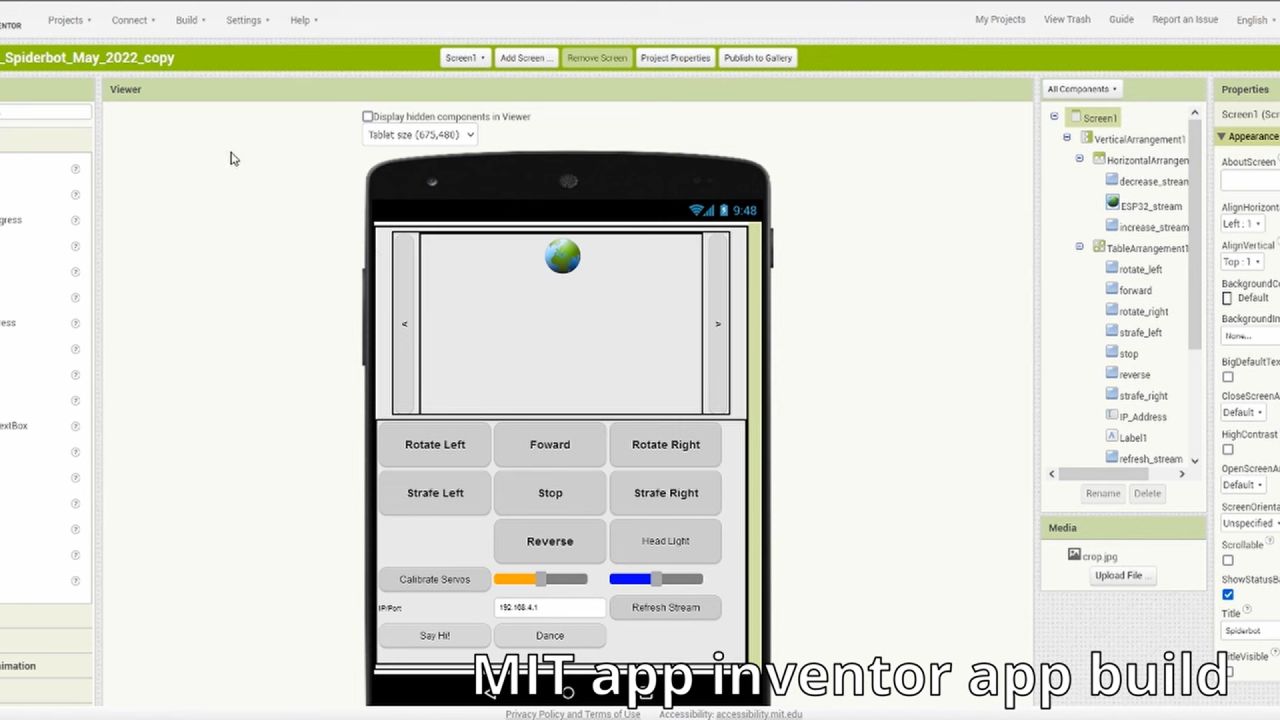
The Android App can be downloaded from the following links:
First turn on the spider bot, and use your wifi settings to find and connect to the wifi access point created by ESP32CAM.
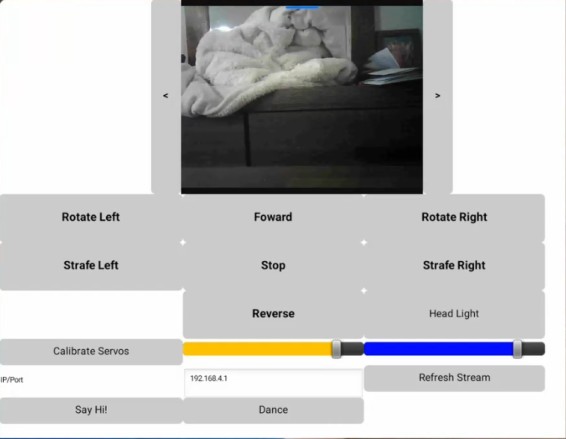
- Live Feed Area: The top portion shows a live video feed, which is from the robot’s camera (ESP32-CAM).
- Directional Control Buttons: There are buttons labeled “Forward,” “Reverse,” “Rotate Left,” “Rotate Right,” “Strafe Left,” and “Strafe Right.” These are for moving the robot in various directions.
- Action Buttons: There’s a “Stop” button, which immediately halts any motion, and a “Calibrate Servos” button, which can be used to reset or calibrate the robot’s servos.
- Head Light Toggle: Toggles the 2W LED for night vision.
- Status/Settings Area: At the bottom, there’s an input field for “IP/Port,” where the user can specify the network address to connect to the robot. There are also “Say Hi!” and “Dance” buttons, which trigger predefined animations or movements.
- Stream Control: A “Refresh Stream” button is used to refresh the video feed.
The Android app is also available as an MIT app inventor project which allows you to customize the app using the free online Android app development suite [MIT app inventor]
Robot Testing & FOV Video Streaming
After the assembly and code upload part is complete, the DIY Spiderbot Hexapod Robot with ESP32-CAM is ready for testing.
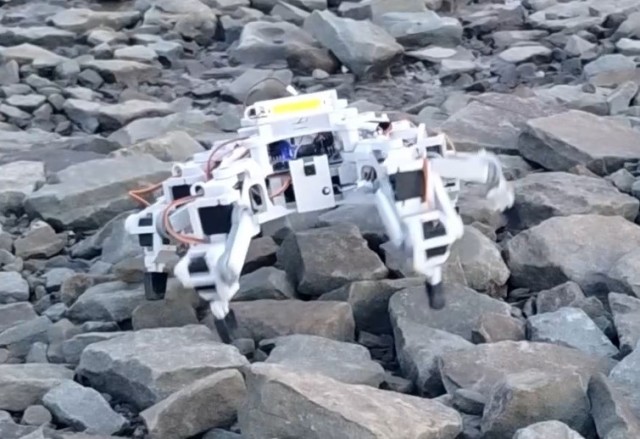
The Robot can perform complex maneuvers such as turning and climbing as well as adjusting the height.
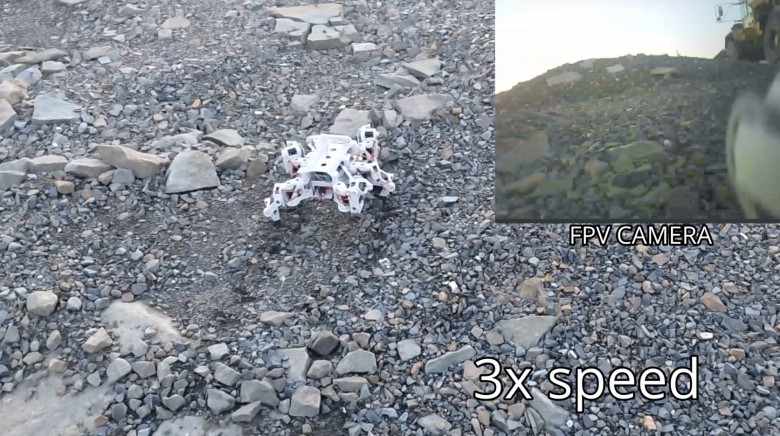
The video streaming can be observed on the Android App.
Video Tutorial with Assembly, Testing, & Much More