


Overview: MicroPython on ESP32 with DS18B20 Temperature Sensor
In this project we will be interfacing DS18B20 Temperature Sensor with ESP32 using MicroPython Code. We will use DS18B20 1-Wire Waterproof Temperature Sensor with ESP32 Board & 0.96″ I2C OLED Display. We will then write a MicroPython Code in uPyCraft IDE. Using the uPyCraft IDE, we can directly upload the firmware to ESP32 Board.
DS18B20 1-Wire Temperature Sensor can be programmed easily to get the correct reading. The accuracy of the sensor is high and can be used to measure the temperature between -55°C to 125°C.
Before proceeding, you can check this Guide: MicroPython on ESP32 using PyCraft IDE – Getting Started. I highly recommend you to follow this guide as it is covers all the basics including setting up the IDE to writing the code & uploading as well.
Bill of Materials
Following are the components required for making this project. All the components can be eaily purchased from Amazon. The components purchase link is given below.
| S.N. | Components Name | Quantity | Purchase Links |
|---|---|---|---|
| 1 | ESP32 Board | 1 | Amazon | AliExpress |
| 2 | 0.96" I2C OLED Display | 1 | Amazon | AliExpress |
| 3 | DS18B20 Temperature Sensor | 1 | Amazon | AliExpress |
| 4 | Resistor 4.7K | 1 | Amazon | AliExpress |
| 5 | Connecting Jumper Wires | 5 | Amazon | AliExpress |
| 6 | Breadboard | 1 | Amazon | AliExpress |
Or if you want more cheaper item then you can purchase the MakePython ESP32 Board from Makerfabs as shown in the image below. The board contains combined ESP32 Chip + 1.3″ I2C OLED Display supports MicroPython.

To learn more about this board and purchase it online, you can visit this link: MakePython ESP32 Board.
DS18B20 Temperature Sensor
DS18B20 is a pre-wired and waterproofed version of the DS18B20 sensor. It is handy for use when you need to measure something far away, or in wet conditions. The Sensor can measure the temperature between -55 to 125°C (-67°F to +257°F). The cable is jacketed in PVC. Check the datasheet here: DS18B20 Sensor Datasheet.
Since it is digital, there is no signal degradation even over long distances. These 1-wire digital temperature sensors are fairly precise, i.e ±0.5°C over much of the range. It can give up to 12 bits of precision from the onboard digital-to-analog converter. They work great with any microcontroller using a single digital pin.

To learn more about DS18B20 Temperature Sensor you can follow these posts:
1. Digital Thermometer using DS18B20 & Arduino with LCD Display
2. Temperature Meter using DS18B20 OLED Display & Arduino
3. Interfacing Multiple DS18B20 Temperature Sensors to Arduino
OLED Display
This SSD1306/SSD1315 is a 0.96/1.3 inch blue OLED display module. The display module can be interfaced with any microcontroller using SPI/IIC protocols. It is having a resolution of 128×64. The package includes display board, display,4 pin male header pre-soldered to board.

We will display the temperature reading in this display. To learn more about the interfacing of OLED Display with ESP32 using MicroPython, follow this guide: Interfacing 0.96″ OLED Display with ESP32 using MicroPython.
Interfacing DS18B20 Temperature Sensor with ESP32 using MicroPython
Circuit Diagram & Connections
Here is a circuit diagram for Interfacing DS18B20 Temperature Sensor with ESP32 using MicroPython Code. The digital output pin is connected to ESP32 GPIO22 Pin. A 4.7K Resistor is used as a pull-up resistor & is connected between digital output pin & VCC Pin.

In case if you are using MakePython ESP32 Board, you can do the following connection as shown in the connection diagram below. This board has an additional 1.3″ OLED Display.

MicroPython Source Code
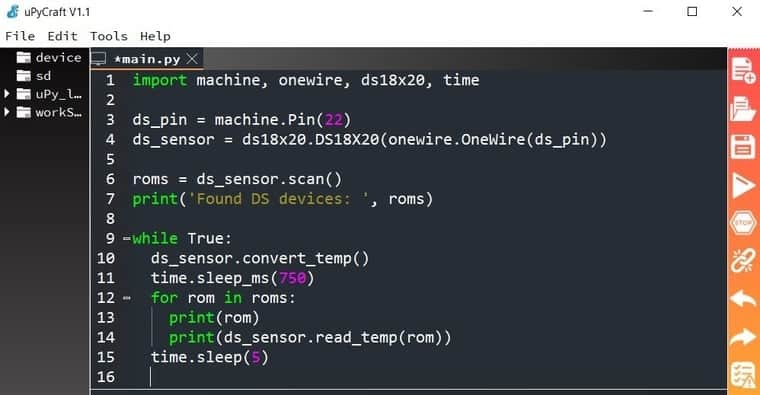
The MicroPython Code is given below. Using this MicroPython Code you can Interface DS18B20 with ESP32 Board & check the output in uPyCraft IDE Python Shell.
Just copy the code below and create a new file in uPyCraft IDE & save it with a name main.py.
|
1 2 3 4 5 6 7 8 9 10 11 12 13 14 15 |
import machine, onewire, ds18x20, time ds_pin = machine.Pin(22) ds_sensor = ds18x20.DS18X20(onewire.OneWire(ds_pin)) roms = ds_sensor.scan() print('Found DS devices: ', roms) while True: ds_sensor.convert_temp() time.sleep_ms(750) for rom in roms: print(rom) print(ds_sensor.read_temp(rom)) time.sleep(5) |
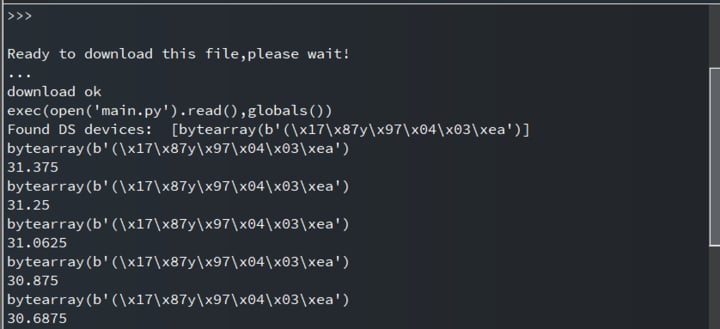
To upload the code use the “Download & Run” Button in PyCraft IDE. As soon as the code is uploaded, the Shell Window will start showing the Temperature.
Interfacing DS18B20 with ESP32 & OLED Display using MicroPython
Circuit Diagram & Connections
Here is a circuit diagram for Interfacing DS18B20 Temperature Sensor & OLED Display with ESP32 using MicroPython Code. The digital output pin is connected to ESP32 GPIO22 Pin. A 4.7K Resistor is used as a pull-up resistor & is connected between digital output pin & VCC Pin. The 0.96″ I2C OLED Display SDA & SCL Pin is connected to GPIO21 (SCL) & GPIO22 (SDA) of ESP32 respectively.

If you are using “MakePython ESP32 Board” the 1.3″ OLED Display I2C Pins are connected to GPIO5 (SDA) & GPIO4 (SCL) of OLED Display. You need to modify the code on the basis of I2C Pins if you are using any other ESP32 Board.
I am using MakePython ESP32 Board. So my connection diagram is given below.

SSD1306 Library
The library to write to the OLED display isn’t part of the standard MicroPython library by default. So, first we need to upload the library to the ESP32 board.
|
1 2 3 4 5 6 7 8 9 10 11 12 13 14 15 16 17 18 19 20 21 22 23 24 25 26 27 28 29 30 31 32 33 34 35 36 37 38 39 40 41 42 43 44 45 46 47 48 49 50 51 52 53 54 55 56 57 58 59 60 61 62 63 64 65 66 67 68 69 70 71 72 73 74 75 76 77 78 79 80 81 82 83 84 85 86 87 88 89 90 91 92 93 94 95 96 97 98 99 100 101 102 103 104 105 106 107 108 109 110 111 112 113 114 115 116 117 118 119 120 121 122 123 124 125 126 127 128 129 130 131 132 133 134 135 136 137 138 139 140 141 142 143 144 145 146 147 148 149 150 151 152 153 154 155 156 157 158 159 160 161 162 163 164 165 166 167 168 169 170 171 172 173 174 175 176 177 178 179 180 181 182 183 184 185 186 187 188 189 190 |
# MicroPython SSD1306 OLED driver, I2C and SPI interfaces from micropython import const import time import framebuf import sys currentBoard="" if(sys.platform=="esp8266"): currentBoard="esp8266" elif(sys.platform=="esp32"): currentBoard="esp32" elif(sys.platform=="pyboard"): currentBoard="pyboard" import pyb # register definitions SET_CONTRAST = const(0x81) SET_ENTIRE_ON = const(0xa4) SET_NORM_INV = const(0xa6) SET_DISP = const(0xae) SET_MEM_ADDR = const(0x20) SET_COL_ADDR = const(0x21) SET_PAGE_ADDR = const(0x22) SET_DISP_START_LINE = const(0x40) SET_SEG_REMAP = const(0xa0) SET_MUX_RATIO = const(0xa8) SET_COM_OUT_DIR = const(0xc0) SET_DISP_OFFSET = const(0xd3) SET_COM_PIN_CFG = const(0xda) SET_DISP_CLK_DIV = const(0xd5) SET_PRECHARGE = const(0xd9) SET_VCOM_DESEL = const(0xdb) SET_CHARGE_PUMP = const(0x8d) class SSD1306: def __init__(self, width, height, external_vcc): self.width = width self.height = height self.external_vcc = external_vcc self.pages = self.height // 8 self.buffer = bytearray(self.pages * self.width) self.framebuf = framebuf.FrameBuffer(self.buffer, self.width, self.height, framebuf.MVLSB) self.poweron() self.init_display() def init_display(self): for cmd in ( SET_DISP | 0x00, # off # address setting SET_MEM_ADDR, 0x00, # horizontal # resolution and layout SET_DISP_START_LINE | 0x00, SET_SEG_REMAP | 0x01, # column addr 127 mapped to SEG0 SET_MUX_RATIO, self.height - 1, SET_COM_OUT_DIR | 0x08, # scan from COM[N] to COM0 SET_DISP_OFFSET, 0x00, SET_COM_PIN_CFG, 0x02 if self.height == 32 else 0x12, # timing and driving scheme SET_DISP_CLK_DIV, 0x80, SET_PRECHARGE, 0x22 if self.external_vcc else 0xf1, SET_VCOM_DESEL, 0x30, # 0.83*Vcc # display SET_CONTRAST, 0xff, # maximum SET_ENTIRE_ON, # output follows RAM contents SET_NORM_INV, # not inverted # charge pump SET_CHARGE_PUMP, 0x10 if self.external_vcc else 0x14, SET_DISP | 0x01): # on self.write_cmd(cmd) self.fill(0) self.show() def poweroff(self): self.write_cmd(SET_DISP | 0x00) def contrast(self, contrast): self.write_cmd(SET_CONTRAST) self.write_cmd(contrast) def invert(self, invert): self.write_cmd(SET_NORM_INV | (invert & 1)) def show(self): x0 = 0 x1 = self.width - 1 if self.width == 64: # displays with width of 64 pixels are shifted by 32 x0 += 32 x1 += 32 self.write_cmd(SET_COL_ADDR) self.write_cmd(x0) self.write_cmd(x1) self.write_cmd(SET_PAGE_ADDR) self.write_cmd(0) self.write_cmd(self.pages - 1) self.write_data(self.buffer) def fill(self, col): self.framebuf.fill(col) def pixel(self, x, y, col): self.framebuf.pixel(x, y, col) def scroll(self, dx, dy): self.framebuf.scroll(dx, dy) def text(self, string, x, y, col=1): self.framebuf.text(string, x, y, col) def hline(self, x, y, w, col): self.framebuf.hline(x, y, w, col) def vline(self, x, y, h, col): self.framebuf.vline(x, y, h, col) def line(self, x1, y1, x2, y2, col): self.framebuf.line(x1, y1, x2, y2, col) def rect(self, x, y, w, h, col): self.framebuf.rect(x, y, w, h, col) def fill_rect(self, x, y, w, h, col): self.framebuf.fill_rect(x, y, w, h, col) def blit(self, fbuf, x, y): self.framebuf.blit(fbuf, x, y) class SSD1306_I2C(SSD1306): def __init__(self, width, height, i2c, addr=0x3c, external_vcc=False): self.i2c = i2c self.addr = addr self.temp = bytearray(2) super().__init__(width, height, external_vcc) def write_cmd(self, cmd): self.temp[0] = 0x80 # Co=1, D/C#=0 self.temp[1] = cmd #IF SYS : global currentBoard if currentBoard=="esp8266" or currentBoard=="esp32": self.i2c.writeto(self.addr, self.temp) elif currentBoard=="pyboard": self.i2c.send(self.temp,self.addr) #ELSE: def write_data(self, buf): self.temp[0] = self.addr << 1 self.temp[1] = 0x40 # Co=0, D/C#=1 global currentBoard if currentBoard=="esp8266" or currentBoard=="esp32": self.i2c.start() self.i2c.write(self.temp) self.i2c.write(buf) self.i2c.stop() elif currentBoard=="pyboard": #self.i2c.send(self.temp,self.addr) #self.i2c.send(buf,self.addr) self.i2c.mem_write(buf,self.addr,0x40) def poweron(self): pass class SSD1306_SPI(SSD1306): def __init__(self, width, height, spi, dc, res, cs, external_vcc=False): self.rate = 10 * 1024 * 1024 dc.init(dc.OUT, value=0) res.init(res.OUT, value=0) cs.init(cs.OUT, value=1) self.spi = spi self.dc = dc self.res = res self.cs = cs super().__init__(width, height, external_vcc) def write_cmd(self, cmd): global currentBoard if currentBoard=="esp8266" or currentBoard=="esp32": self.spi.init(baudrate=self.rate, polarity=0, phase=0) elif currentBoard=="pyboard": self.spi.init(mode = pyb.SPI.MASTER,baudrate=self.rate, polarity=0, phase=0) self.cs.high() self.dc.low() self.cs.low() global currentBoard if currentBoard=="esp8266" or currentBoard=="esp32": self.spi.write(bytearray([cmd])) elif currentBoard=="pyboard": self.spi.send(bytearray([cmd])) self.cs.high() def write_data(self, buf): global currentBoard if currentBoard=="esp8266" or currentBoard=="esp32": self.spi.init(baudrate=self.rate, polarity=0, phase=0) elif currentBoard=="pyboard": self.spi.init(mode = pyb.SPI.MASTER,baudrate=self.rate, polarity=0, phase=0) self.cs.high() self.dc.high() self.cs.low() global currentBoard if currentBoard=="esp8266" or currentBoard=="esp32": self.spi.write(buf) elif currentBoard=="pyboard": self.spi.send(buf) self.cs.high() def poweron(self): self.res.high() time.sleep_ms(1) self.res.low() time.sleep_ms(10) self.res.high() |
First open a new file in uPyCraft IDE paste the above code. Save the file as a name “SSD1306.py“. Click the “Download & Run” Icon. This will upload the file to the ESP32 board.
The uPyCraft console window should the following message.

Now you can import the SSD1306 Library and use it on the Code Part.
Main Code
After downloading the SSD1306.py file to the ESP32 Board, you can now upload the main code. To do that open another file and paste the below code. Save it as a name “main.py“.
|
1 2 3 4 5 6 7 8 9 10 11 12 13 14 15 16 17 18 19 20 21 22 23 24 |
from machine import Pin,I2C import ssd1306 import time import machine import onewire dat = machine.Pin(22) # the device is on GPIO0 i2c = I2C(scl=Pin(5), sda=Pin(4), freq=100000) #Init i2c lcd=ssd1306.SSD1306_I2C(128,64,i2c) #create LCD object,Specify col and row ds = ds18x20.DS18X20(onewire.OneWire(dat)) # create the onewire object roms = ds.scan() # scan for devices on the bus try: while True: ds.convert_temp() time.sleep_ms(750) #The reading temperature needs at least 750ms for rom in roms: lcd.fill(0) lcd.text("Temperature:",10,16) lcd.text(str(ds.read_temp(rom)),24,40) lcd.show() except KeyboardInterrupt: pass |
Note: Please change the OLED Pin in the code according to the I2C Pins of your ESP32 Board.
As soon as the code is uploaded, the OLED Display will start displaying the temperature as shown in the image below.

Video Tutorial & Guide


